
The clink of silver against fine bone china echoed through the cavernous dining room, a sharp, metallic sound that seemed to slice through the suffocating silence.
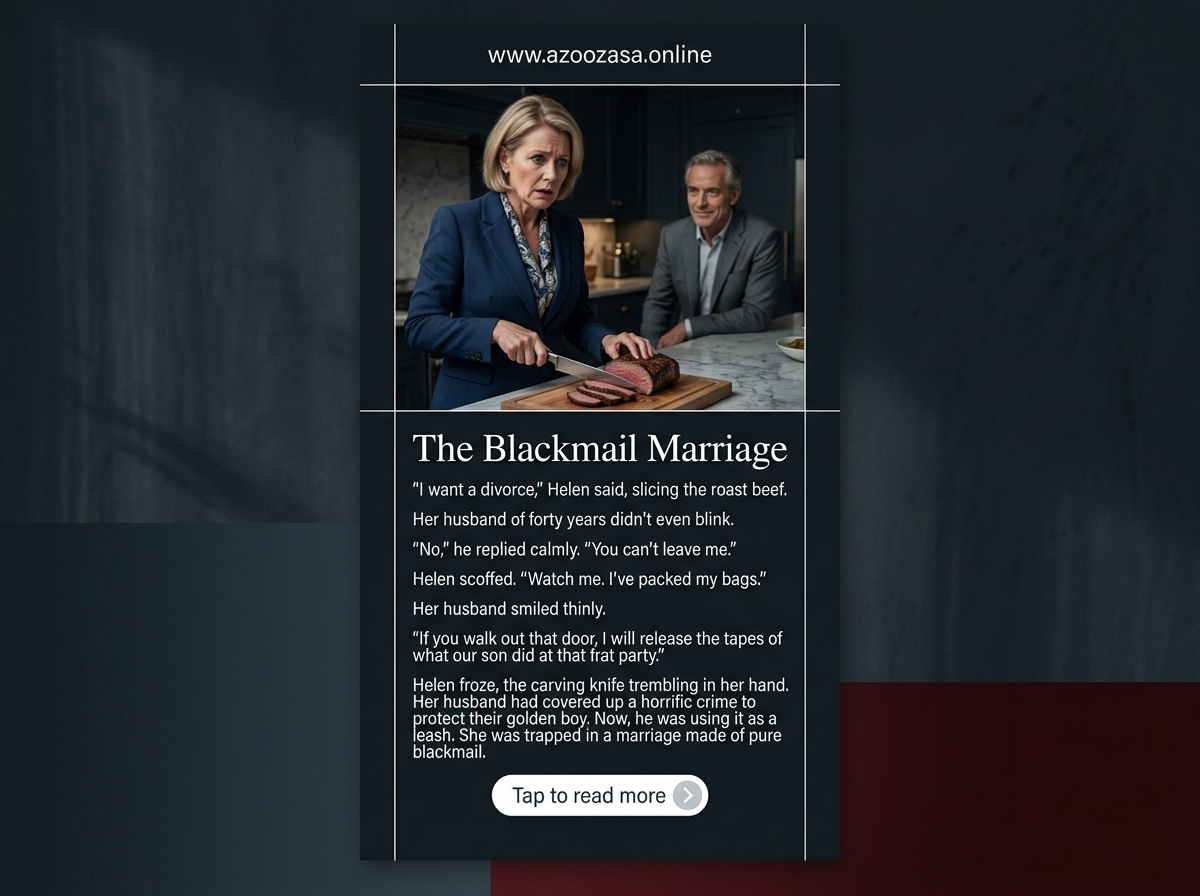
“I want a divorce,” Helen said.
She was slicing the roast beef, her movements methodical, almost mechanical. The rich, red juices bled onto the pristine white platter, a stark contrast that made her stomach churn.
Across the mahogany table, stretching like a barren wasteland between them, sat her husband of forty years. Arthur didn’t even blink.
He took a slow, deliberate sip of his Cabernet, savoring the vintage before carefully setting the crystal glass down.
“No,” he replied calmly, wiping his mouth with a linen napkin. “You can’t leave me.”
Helen scoffed, a bitter, breathless sound escaping her throat. She set the carving knife down, suddenly feeling the immense weight of the oppressive mansion around her. “Watch me. I’ve packed my bags. They are sitting by the front door, Arthur. I am leaving tonight.”
Arthur leaned back in his high-backed leather chair, steepling his fingers. He smiled, a thin, bloodless stretching of his lips that never reached his pale eyes. “If you walk out that door, Helen, I will release the tapes of what our son did at that frat party.”
Helen froze. Her hand hovered over the table, trembling so violently she had to grip the edge of the mahogany wood to steady herself. The air in the room suddenly felt too thin to breathe.
*The frat party.*
It was a nightmare buried beneath fifteen years of country club dinners, charity galas, and carefully curated family portraits. Their son, David—their golden boy, now a respected state senator with a beautiful wife and two cherubic daughters—had made a catastrophic, horrific mistake during his sophomore year of college. A girl had been gravely injured, her silence bought with an obscene amount of money, a private Swiss medical facility, and a wall of intimidation.
Arthur had handled it. He had swept in with his team of fixers, his bottomless bank accounts, and his utter lack of morality, and he had erased the crime from existence. Helen had lived with the agonizing guilt ever since, terrified of the truth, yet eternally bound to Arthur for protecting their boy.
Now, he was using it as a leash.
“You… you destroyed those tapes,” Helen whispered, her voice cracking. “You swore to me there was no evidence.”
“I am a businessman, Helen,” Arthur stated, slicing a piece of his own meat. “I never destroy leverage. I merely archive it. You will go upstairs, you will unpack your bags, and you will come down tomorrow morning for breakfast with a smile on your face. Because if you do not, David’s political career, his marriage, and his freedom will be entirely dismantled by noon tomorrow.”
He took a bite, chewed methodically, and swallowed. “Are we understood?”
Helen didn’t answer. She turned on her heel and walked out of the dining room, her footsteps heavy on the marble floors. She bypassed her packed Louis Vuitton luggage by the front door and ascended the grand staircase. She was trapped. It was a marriage constructed of silk and gold, but its foundation was pure, unadulterated blackmail.
For three days, Helen played the ghost. She unpacked her bags. She attended a charity luncheon. She sat across from Arthur at dinner, eating silently, a perfectly manicured prisoner.
But beneath the docile facade, a cold, terrifying clarity had begun to take root.
Arthur had made a critical miscalculation. He assumed that because she had spent forty years playing the role of the obedient society wife, she was weak. He had forgotten that before she was Mrs. Arthur Vance, she was Helen Sterling, the daughter of a ruthless corporate litigator, a woman who had deferred her own acceptance to law school to help build Arthur’s empire from the ground up.
He thought the tapes were a leash. Helen decided they were going to be a noose.
Arthur left for a week-long symposium in Geneva on Thursday morning. The moment his black town car disappeared down the long, oak-lined driveway, Helen went to work.
She knew this house better than she knew the lines on her own face. She knew Arthur’s habits, his paranoia, and his hubris. If he had kept the tapes, they weren’t in a bank vault downtown; he was too much of a control freak for that. They were here, in his private, biometric-locked study—a room she was strictly forbidden from entering.
Defeating the lock took her less than an hour. She had long ago noticed that Arthur, despite his brilliance, was a creature of habit. He kept a physical override key in a hollowed-out vintage encyclopedia in the library, a backup for when the power failed.
The study was cold, smelling of stale cigar smoke and old paper. Behind a portrait of Arthur’s grandfather was the wall safe. This was trickier. It required a six-digit code.
Helen stood before the steel panel, closing her eyes. What would an arrogant narcissist use as his master code? Not his birthday. Not hers. Not David’s.
She opened her eyes and punched in the date Arthur had taken his company public—the day he became a billionaire. *0-9-1-4-8-8*.
The light turned green. The heavy steel door clicked and hissed open.
Inside lay stacks of bearer bonds, a velvet box containing his mother’s diamonds, and, tucked in the back corner, a sealed manila envelope. Helen’s heart hammered against her ribs as she pulled it out. Inside was a sleek, black USB drive, modernizing whatever original format the footage had been captured on.
She took the drive to his mahogany desk, booted up his secure laptop, and plugged it in. Her hands shook as a single video file appeared on the screen. She double-clicked it.
The footage was grainy, taken from a hidden security camera Arthur had installed at the fraternity house he owned and funded. Helen forced herself to watch as the horrific events of that night unfolded. It was sickening. David was out of control, fueled by alcohol and rage.
But as the terrible incident concluded, the video didn’t stop. The timestamp skipped forward two hours.
Helen leaned closer to the screen, her breath catching.
The door to the frat house opened, and Arthur walked in, accompanied by two large men in suits. The camera, hidden in a smoke detector, captured crystal-clear audio. It captured Arthur surveying the scene. It captured him handing thick envelopes of cash to the frat brothers, his voice a low, menacing growl as he threatened their lives if they ever spoke a word.
More importantly, it captured Arthur orchestrating the cover-up, moving the victim, and explicitly detailing a plan to bribe the local police chief and launder hush money through his corporate charity.
Helen sat back, the blood roaring in her ears.
Arthur hadn’t just covered up their son’s crime. He had committed half a dozen federal offenses doing it—obstruction of justice, bribery, racketeering, and money laundering. And he was arrogant enough to keep the unedited master file because he liked watching himself play god.
A slow, dangerous smile crept across Helen’s face. The paralyzing fear that had gripped her for days evaporated, replaced by a fiery, intoxicating sense of power.
She spent the next forty-eight hours dissecting Arthur’s safe. She photographed his private ledgers, tracing the offshore accounts he had used to fund the bribes and evade taxes for decades. She compiled a master dossier—a digital nuke that would not only destroy Arthur’s reputation but guarantee he would spend the rest of his miserable life in a federal penitentiary.
She uploaded the entire package to an encrypted, automated server. A dead man’s switch.
When Arthur returned from Geneva, the house was immaculate. Dinner was served at exactly eight o’clock. Roast chicken, wild rice, and asparagus.
Arthur sat at his end of the table, looking smug and refreshed. He poured himself a glass of Pinot Noir, eyeing Helen with a patronizing smirk.
“I trust you had a quiet week, Helen?” he asked, his voice dripping with condescension. “No more foolish talk of packing bags?”
Helen finished chewing a piece of asparagus, dabbed her lips with her napkin, and reached into the pocket of her silk cardigan. She pulled out a small, silver flash drive and tossed it across the length of the mahogany table. It skittered over the polished wood and came to a halt right next to Arthur’s wine glass.
Arthur frowned, looking down at the drive. “What is this?”
“That,” Helen said, her voice smooth as glass, “is a copy of the frat house tape. The unedited version, Arthur. The one that includes your starring role at the two-hour and fourteen-minute mark.”
Arthur’s face went rigid. The color completely drained from his cheeks.
“I also included high-resolution photographs of your private ledgers from the wall safe,” Helen continued, leaning forward, her eyes locking onto his. “The Cayman accounts, the bribes to Chief Morrison, the fraudulent tax filings from 1998 to the present.”
“You… you couldn’t have,” Arthur stammered, his facade of invulnerability shattering in an instant. He reached for the drive, his hand shaking slightly.
“I did,” Helen said simply. “And I have programmed all of that information onto a secure server. If I do not log in and reset the timer every twenty-four hours, that dossier will be automatically emailed to the Department of Justice, the IRS, and the editorial desk of the New York Times.”
Silence descended upon the dining room, heavier and more suffocating than ever before. But this time, it wasn’t Helen who couldn’t breathe. Arthur stared at her, his mouth slightly open, looking like a man who had just stepped on a landmine and heard the click.
“You would destroy your own son?” Arthur whispered, grasping at his final straw.
“David will face the consequences of his actions. I have already retained the best defense attorney in the country for him. He will survive it,” Helen said, her voice resolute and unyielding. “But you, Arthur? You are seventy-two years old. You won’t survive a decade in federal prison. They will take your company. They will take your wealth. They will strip you of everything that makes you who you are.”
She stood up, smoothing the front of her skirt.
“My bags are in the car,” Helen announced, looking down at the man who had kept her captive for four decades. “My attorney will send you the divorce papers in the morning. I am taking seventy percent of our total assets, liquid and physical. You will sign the papers without contest, and you will never attempt to contact me or David again.”
Arthur opened his mouth to speak, to threaten, to bargain, but no words came out. For the first time in his life, he had absolutely no leverage.
“If you hesitate, Arthur, I let the timer run out,” Helen said, turning her back on him.
She walked out of the dining room, the sharp click of her heels echoing triumphantly on the marble floor. As she opened the heavy oak front door and stepped out into the cool, evening air, she took her first real breath in forty years. The night was dark, but to Helen, the future had never looked brighter.
—
How did you feel about Helen’s approach to outsmarting her husband—would you have preferred she confronted her son David before executing her plan, or was taking down Arthur the right first step?



0 comments