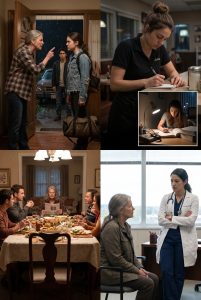
 The front door of our home in Columbus, Ohio, has a heavy brass knocker, but on the night of Lisa’s eighteenth birthday, nobody used it. It was slammed shut with a force that seemed to reverberate through the next fourteen years of my life.
I can still see her standing there, clutch-bag in one hand, a worn backpack slung over her shoulder, and sixty dollars—all the cash she had—stuffed into the pocket of her frayed denim jacket. I had given her an ultimatum: “It’s him or us, Lisa. You either leave that boy, or you pack your things and find another place to live.”
I thought she would break. I thought she would cry, realize she was only eighteen, and understand that her father and I only wanted what was best for her. We didn’t trust Carlos. He was older, had a motorcycle, and came from a part of town we didn’t understand. We wanted her to go to Ohio State, to stay safe, to be our little girl. Instead, she looked at me with an icy determination that I’d never seen in her before.
“I’m leaving, Mom,” she said, her voice barely a whisper but solid as granite.
She walked out into the chilly November drizzle, getting into Carlos’s battered Honda. And just like that, she was gone.
For fourteen years, her chair stayed empty at every Thanksgiving, every Christmas, and every Easter. My husband, Arthur, passed away six years after she left, his heart worn out by a lifetime of hard work and, I suspect, the quiet grief of a fractured home. We never spoke of her directly, but her absence was a physical presence in our house, like a piece of furniture we couldn’t move and couldn’t ignore. Every time the phone rang on a holiday, my heart would leap, only to be crushed when it was just a telemarketer or a neighbor.
Then, last month, my sister, Clara, came over for coffee. She didn’t say a word as she slid a faded newspaper clipping across the table. It was from the Columbus Dispatch. There, in a small feature about local medical advancements, was a photograph of a woman with dark, intense eyes and a confident, kind smile. The headline read: “Dr. Lisa Garcia, Top Pediatric Surgeon, Appointed to Head of Surgery at Metro Health.”
I stared at the name. Lisa Garcia. She had taken his name. She had become a doctor. And she had done it all without us.
I put the paper down very carefully, my hands trembling so much I spilled a few drops of coffee. For days, I couldn’t sleep. I’d look at the kitchen table, then at the clipping, and feel a mixture of immense pride and crushing, suffocating guilt. I had tried to protect her by throwing her away, and she had survived—no, she had thrived—in spite of me.
Last Tuesday, I drove to the Metro Health Medical Center. The campus was sprawling, a maze of glass and steel that made me feel incredibly small. I sat in my Buick in the parking garage for nearly an hour, gripping the steering wheel, before I found the courage to walk inside.
I found her office on the fourth floor of the pediatric wing. The placard on the wall read: Lisa Garcia, MD, FACS. I sat in the waiting room for forty minutes, watching the bustling nurses, the anxious parents, and the occasionally glimpsed doctors in scrubs. My heart hammered against my ribs like a trapped bird. Every time the door opened, I braced myself.
Finally, a receptionist called my name. “Mrs. Thompson? Dr. Garcia can see you now.”
I walked into her private office. It was filled with books, framed diplomas, and drawings from young patients. And there she was. She was thirty-two now, her hair pulled back, wearing dark blue scrubs under a white lab coat. She looked so much like her father it took my breath away.
She didn’t hug me. She didn’t even step forward. Her eyes, once so familiar, narrowed slightly as she looked at me. She didn’t look angry; she looked guarded, like a soldier observing an unexpected visitor at the border.
“Mom,” she said, her voice even. “What are you doing here?”
“I… I saw the article, Lisa,” I managed to say, my voice cracking. I held up the folded clipping, as if it were an offering or an apology. “I wanted to see you. To see if it was true.”
She looked at the paper, then back at me. The silence in the room was heavy, filled with the ghosts of fourteen years of missed birthdays, graduations, and dinners. She walked over to the door, closed it quietly, and then motioned for me to sit in a chair opposite her desk. She didn’t sit; she leaned against the edge of her desk, crossing her arms.
“It’s true,” she said. “I’m a surgeon.”
“I’m so proud of you, Lisa,” I said, the tears finally spilling over. “Your father would have been—”
“Don’t,” she interrupted, her voice sharp but not loud. “Don’t bring Dad into this now. You made your choice, Mom. You told me it was him or you.”
“I was scared,” I whispered, pressing a tissue to my eyes. “Carlos… we didn’t know him. We wanted you to have a life.”
Lisa let out a short, humorless laugh. “You wanted me to have the life you chose for me. You didn’t trust me. And as for Carlos? We’ve been married for twelve years. He worked two jobs so I could go to college. He took night shifts so I could sleep before my residency exams. He was the one who believed in me when I had nothing but a backpack and sixty dollars.”
She stood up and walked to the window, looking out over the city. “After all this time, are you here because you finally understand what your words took from us, or are you just curious to see if I failed?”
“No!” I cried, rising from my seat. “No, Lisa, never. I never wanted you to fail. I was stubborn, and I was wrong. I was so wrong. I’ve missed you every single day. I’ve sat at that table every year, looking at your empty chair, wishing I could take that night back.”
She turned to face me. The guarded look was still there, but beneath it, I could see a flicker of the girl who used to read under her bedsheets with a flashlight.
“It took me years to forgive you, Mom,” she said softly. “But I did. Because holding onto that anger was too heavy, and I had too much work to do. But forgiveness doesn’t mean we can just go back. You missed my wedding. You missed my graduation. You don’t know my children—you have two grandkids, Mom. Max is six, and Sofia is four.”
The news of grandchildren hit me like a physical blow. A boy and a girl. I had grandchildren I’d never seen, whose names I’d never heard. The weight of my pride, of that single, stubborn night, felt like a mountain crushing down on me.
“I don’t expect you to forgive me,” I sobbed, gripping the back of the chair. “I don’t expect anything. I just… I just wanted to see you. To tell you I’m sorry. If you want me to leave, I’ll go.”
Lisa was silent for a long moment. She looked at her watch, then back at me. The hardness in her eyes seemed to soften, just a fraction.
“I have a surgery in twenty minutes,” she said. “I can’t talk right now.”
I nodded, feeling the familiar sting of rejection, and turned toward the door. My hand was on the knob when her voice stopped me.
“But Max has a T-ball game on Saturday morning,” she said. “And Sofia loves stories. Carlos and I… we still live in Columbus. Over in Clintonville.”
I turned back, barely daring to breathe. “Lisa?”
“If you want to meet them,” she said, her voice trembling slightly for the first time, “you can come. Saturday at ten. At the park on North Broadway.”
She didn’t offer a hug, and she didn’t say she loved me. But she had given me a time and a place.
“I’ll be there,” I said, my voice barely a whisper. “I’ll be there, Lisa.”
She gave a small, tentative nod, then walked past me to open the office door, ushering me back into the bustling hospital. As I walked out into the cold November air, the burden of fourteen years didn’t vanish, but for the first time, it felt like something I might eventually be able to carry. I had a lot of years to make up for, and a game on Saturday to attend.