Every Thursday at precisely six in the evening, the back door of the small, cedar-shingled ranch on Elm Street would click shut, and the sound of my husband’s car engine would rise through the heavy suburban air of suburban Ohio.
He was always dressed the same: a crisp, button-down shirt. Mostly pale blue or oxford white, though he occasionally wore a light plaid. They were always freshly laundered and starched, smelling faintly of the dry cleaner’s paper and wire.
“Going bowling, Heumy,” David would say, tossing a gentle, habitual wave toward the kitchen where I stood. “Don’t wait up.”
For nineteen years, I didn’t.
I kept my peace, but the dry-cleaning tickets began to pile up. I kept them in an old shoe box in the back of my closet—not out of suspicion at first, just an odd habit of a meticulous homemaker who tracks the household pennies. Over almost two decades, they accumulated like silent, paper-thin witnesses. By my calculations, those Thursday-night runs had cost us $4,680. Over nineteen years, that was a small fortune spent on starch and press, especially for a man who went to throw heavy balls at wooden pins in a smoky alley. But David was a quiet man, an estimator for a local construction firm, and he had always been particular about his appearance. I assumed the bowling league had some unwritten dress code, or maybe he simply believed a man should look respectable, even when playing a casual sport.
Then, last month, the pattern shattered.
I was at the local dry cleaner, handing over a fresh bundle to old Mr. Henderson behind the worn counter. I had found three extra Thursday-night tickets crumpled in David’s car console and wanted to settle the tab. Mr. Henderson, whose family had run the business on Main Street since the seventies, peered through his wire-rimmed glasses at the receipts.
He looked at the dates, then up at me, his brow furrowing with gentle confusion.
“You know, Heumy,” he said, tapping a finger on the slip. “I’ve always wondered about David’s schedule. He’s been bringing these in every single Friday morning for as long as I can remember. But these aren’t bowling shirts, you know. They’re oxford cloth, sometimes linen. Most of the boys in the Thursday league wear those polyester jersey things with the names embroidered on the back. David always looks like he’s going to a board meeting, or maybe a service.”
My stomach did a slow, cold turn. “Bowling’s just an informal league, I guess,” I managed, though my voice sounded hollow to my own ears.
“Well, maybe,” Henderson replied, handing over my change. “But he sure goes through a lot of formal starch for a 10-pin match.”
I walked out into the pale autumn afternoon, the paper slips feeling suddenly heavy in my hand. Suburbia is built on small, comfortable illusions, on the predictability of lawns being mowed and cars leaving at six o’clock. But a nineteen-year secret isn’t a small illusion; it is an entirely different life lived in parallel to your own.
I didn’t go home. Instead, I sat in my sedan, pulled out my phone, and looked at the addresses printed on the slips—not the dry cleaner’s, but the small, handwritten notations on the back of David’s old calendar planner where he had occasionally jotted down Thursday reminders. The notations were always a simple street address on the north side of town: 1044 Oakridge.
I put the address into the GPS. It was only fifteen minutes away, in an older, leafy neighborhood where the grand Victorian homes had long been converted into offices and community spaces.
When I pulled up, the sign on the front lawn made the air leave my lungs in a rush: The Oakridge Center for Loss and Hope. Underneath, in smaller, weathered script, it read: Grief & Bereavement Support Groups.
My fingers gripped the steering wheel so hard my knuckles turned white. It was a grief center.
I walked up the creaking wooden steps, the heavy oak door giving way to a quiet, dimly lit hallway that smelled of old wood, lavender, and damp coats. A woman with silver hair and a kind, tired face looked up from a desk at the end of the hall.
“Can I help you?” she asked softly.
“I… I’m looking for some information,” I stammered, my heart hammering against my ribs. “My husband, David Bilurren. I think he… I think he comes here.”
The woman’s expression shifted, a quiet realization dawning in her eyes. “Are you Heumy?” she asked.
I could only nod.
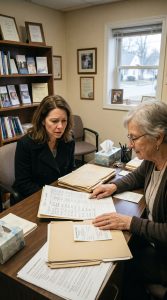
She stood, gesturing for me to follow her into a small, cluttered office filled with mismatched armchairs and bookshelves holding pamphlets on mourning and survival. She introduced herself as Margaret, the director of the center.
“Sit down, please,” she said.
I sat, clutching my purse to my chest like a shield. “How long has he been coming here?” I asked, my voice barely a whisper. “He told me he was bowling. Every Thursday.”
Margaret pulled a worn, manila folder from a filing cabinet behind her. She opened it on the desk between us, revealing a stack of paper and a yellowed sign-in sheet.
“Your husband has been attending our Thursday evening support group since late 2005,” Margaret said, her voice gentle, without judgment.
2005.
The year was an open wound.
“He lost a son,” she added, looking at me with a profound, aching empathy.
“That was our son,” I said, the words catching in my throat, hot and sharp. “Leo. He was seven when the illness took him. He was our only child.”
My mind raced back to that terrible year, the blur of hospital corridors, the sterile smell of the pediatric ICU, and the agonizingly quiet house we had returned to. When Leo died, I had wept until I thought my chest would split open. But David… David had been a rock. Too much of a rock. At the funeral, he had stood there in a dark suit, his face an impassionless mask, holding my hand but seemingly entirely detached. He didn’t cry. Not when the casket was lowered, not when the condolences were offered, not when we packed up Leo’s tiny shoes. I had hated him a little for that, for his silent, untouchable strength. I had thought he didn’t feel it the way I did, that he had somehow moved on while I remained buried in the grief.
“He never cried,” I told Margaret, tears finally spilling over my lashes. “Not once. I thought he was cold. I thought he just wanted to forget.”
Margaret shook her head slowly, sliding the folder closer to me. “Men grieve differently, Heumy. Often, in our culture, they feel they have to be the anchor, the one who doesn’t break, so their families can survive. But the pressure has to go somewhere.”
She pointed to the sign-in sheet. The handwritten pages were filled with David’s neat, architectural script, week after week, year after year. Every Thursday, for nineteen years.
“He has 312 visits on this sheet alone, and there are more folders in the archive,” Margaret said. “He was a cornerstone of the Thursday night group. He would come here, put on a clean shirt, and he would weep. For nineteen years, he sat in those chairs and allowed himself to be entirely undone, away from the world, away from you, so that when he came back to Elm Street, he could be the strong husband you needed to survive.”
She reached into the folder and pulled out a small, faded paper—the last ticket. It wasn’t a dry-cleaning receipt. It was a handwritten note David had left in the folder, dated just the week before.
“He was going to tell you this week,” Margaret whispered. “He told us he felt he was finally ready. That he was tired of carrying the secret, but he was always so afraid that if you saw him break, you both would drown.”
I took the small piece of paper. It was his handwriting, a brief message to the group, thanking them for being his “salvation” and noting that he hoped to bring his wife next time, to finally bridges the chasm of silence we had lived in.
My chest ached, not with anger, but with a profound, overwhelming wave of love and sorrow. For nineteen years, my husband hadn’t been escaping me; he had been protecting me, carrying the heaviest burden of our lives in the quiet, starched privacy of a Thursday night, so that he could keep our home whole.
I looked down at the sheets, seeing the visual evidence of his nineteen-year journey of unspoken grief. I realized then that the most enduring love is often the one that suffers in the dark, just to keep the light on for the one they love.
“Thank you, Margaret,” I said, rising from the chair, the tissue in my hand damp and crumpled.
I drove home, the autumn sun dipping below the horizon, casting long, golden shadows over our quiet neighborhood.
When the garage door opened and the sedan was parked, I went inside and walked straight to the laundry room. I took a fresh, blue oxford shirt from the hanger, feeling the crisp, professionally starched fabric beneath my fingers. I took it upstairs, to our bedroom, and laid it out on David’s side of the bed.
When the back door clicked shut at precisely six o’clock that evening, I didn’t stay in the kitchen.
I met him in the hallway. He looked tired, his eyes carrying the weary, everyday look of a man who estimation for a living, but when he saw me, he offered that same gentle, habitual wave.
“Hey, Heumy,” he said, reaching for his coat. “Just getting ready…”
He stopped when he saw my face.
“David,” I said, my voice soft but steady, reaching out to take his hand. The hand that had held mine through a funeral, through nineteen years of quiet dinners, and through the invisible weight of a shared, unspoken loss.
“Let’s go bowling together,” I said, a tear finally escaping and running down my cheek. “But first, I think we should go to Oakridge.”
The breath caught in his throat, and for the first time in nineteen years, the mask finally, completely shattered. He didn’t say a word, but as he pulled me into his chest, the starch of his clean shirt was soon damp with the tears we should have cried together, all those years ago.