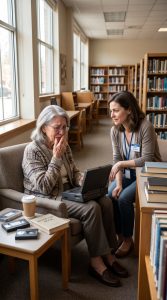
Every Tuesday morning at ten o’clock sharp, the glass double doors of the public library in Cuyahoga Falls, Ohio, clicked open against the damp autumn breeze, and I slipped inside before the rush of the midday book club.
For eight years, since Arthur passed in the palliative wing of St. Thomas Hospital, this building had been the only place in Summit County where nobody looked at me with pity. Widows of a certain age understand the quiet exile that follows a long illness. First come the casseroles and the sympathetic cards; then the neighbors stop crossing the street to say hello because they do not know what to do with your grief; and eventually, you exist in a silent ranch house with too many unused rooms and a rotary phone that only rings with automated calls about Medicare supplements.
At the library, however, silence was not an absence; it was the policy.
Every single Tuesday, the same librarian was at the reference desk. Her name tag read Emily. She was thirty-nine years old, with soft brown hair pulled into a sensible knot, tortoise-shell reading glasses, and an unobtrusive kindness that felt like clean water. Without ever making a show of it, Emily saved my favorite seat: the deep corduroy wing chair tucked beneath the south-facing casement window, right beside the local history stacks. There was always a fresh paper napkin beside the brass lamp, and whenever the morning sun grew too sharp, the beige Venetian blind was already angled just right to keep the glare off my page.
Last week, that gentle rhythm broke.
I had stepped up to the circulation counter, placing a thick hardback biography and my library card on the wood. I had been combing through my checking statements over the weekend, tracing a persistent quarterly charge of $45 labeled CFPL Endowment Fund. I knew our joint account had been settled years ago, yet the bank continued to clear the debit under Arthur’s name.
“Emily, dear,” I asked, leaning in so as not to disturb the students typing nearby, “I think Arthur’s old account might still have a recurring quarterly donation attached. I didn’t set it up, and eighty dollars every few months adds up when you’re living on Social Security and survivor benefits. Could you check the ledger?”
Emily stopped scanning. Her hand froze over the barcode reader. She looked down at the mahogany counter, her chest rising and falling in a deep, measured breath. When she raised her head, her face had gone completely pale, though her hazel eyes were steady.
“It wasn’t an accounting mistake, Mrs. Miller,” Emily whispered. “Your husband set up that quarterly memorial fee in 2017, just before his final rounds of radiation. He told me that one day you’d scrutinize the statements and ask about the missing fees. He left something in the archive room for that exact morning.”
She reached beneath the desk and retrieved a heavy cloth-bound folio with an envelope taped across its spine. In Arthur’s familiar, uneven script—the hand of a man who spent forty years adjusting valves on assembly lines—my name was written: Martha.
“Go into Study Room B,” Emily said gently, gesturing toward the back hallway. “I already loaded the player for you.”
My fingers went numb around the cardboard cup of black coffee I had carried in from the corner gas station. The coffee went stone cold in my hand as I walked down the carpeted corridor. Inside the small study room, a television monitor sat illuminated beside an old video deck.
I set the box down and pulled out the cassettes. There were three VHS-C tapes, neatly stacked and labeled. With trembling fingers, I slid the first tape into the adapter and pressed play.
The screen flickered with gray tracking static before snapping into focus.
Arthur sat in the green recliner in our living room, wearing the navy cardigan with the frayed elbows I had mended a dozen times. The oxygen cannula rested across his cheekbones, but his mouth curved into that same quiet, reassuring smile he had given me the day we signed the mortgage on our house.
“Hey, Martha,” his voice crackled through the small speaker, thick and low. “If you’re watching this, you finally caught me stealing forty-five dollars every three months from the savings. You always had an eye like a hawk for the checkbook.”
He gave a dry, soft laugh that broke into a brief cough before he steadied himself.
“I know you’ve been spending your Tuesdays there,” Arthur said, leaning slightly toward the lens. “I knew you would. You always found peace in the quiet stacks when things got hard. But I didn’t want you to wander in there just to sit with memories. Keep reading for me, Martha. Keep turning pages. Because there’s a part of our story we never got to write together.”
Arthur took a deep breath, his knuckles whitening where they rested on the arm of the recliner.
“Take the last tape now, Marth. Don’t be frightened. Just watch it.”
The screen fizzled back to black.
My heart hammered against my ribs with terrifying force. My hands shook so hard I nearly dropped the small plastic cartridge as I traded it in the tray.
When the third tape started, the setting was entirely different. It was recorded in 2017 inside the bright, generic conference room of an attorney’s office down on Market Street. Arthur sat on one side of a long laminate table.
Beside him sat a woman.
She wasn’t wearing her glasses, and her hair hung loose across her shoulders, but there was no mistaking the bone structure. The slight, stubborn cleft in the chin. The exact shape of the nose. And the eyes—wide, hazel-green with tiny golden flecks near the pupils, the exact eyes that looked back at me every morning from my bathroom mirror.
It was Emily.
Arthur reached over and covered her hands with both of his calloused palms.
“Martha,” Arthur spoke, his voice wavering with a raw grief that forty years of marriage had never fully exposed. “This is Emily. We placed her in 1987.”
The air left my chest in one sharp, agonizing gasp.
-
The year the rubber plants shut their gates. The year Arthur had been laid off for fourteen months, our gas had been turned off in November, and we had sold our wedding bands just to keep the bank from foreclosing on the house. I had been twenty-two years old, sick, malnourished, and terrified. When the baby came early in the freezing county clinic, the doctor told us plainly that without private health insurance or income, we could not pay for the incubator she needed to survive her weak lungs. We had signed the closed adoption papers through tears so heavy I could barely see the ink.
We had promised each other never to speak of it again, burying the ache under decades of overtime shifts and silent Sunday mornings. It was a secret born of poverty and shame—the unforgiving reality of a working-class life where choosing between surrendering a child or watching her starve had felt like no choice at all.
“I never stopped searching, Marth,” Arthur said on the tape, tears sliding down into the gray whiskers on his jaw. “It took me five years and every spare dollar I could scrape from scrap jobs. Emily’s parents were good people down in Canton. They gave her a wonderful life. When I found her, she was working in Akron as a researcher. She didn’t hold anger toward us. She understood.”
On the screen, Emily squeezed Arthur’s hand in return, her own eyes brimming with tears.
“Arthur told her you came to the library every Tuesday,” Arthur’s recorded voice continued softly. “She applied for the head clerk position here six months before I passed, just so she could watch over you. She didn’t want to shock you while you were nursing me to the end, Martha. She wanted to give you space. But she wants you to know she loves you. She wants you to know you never failed her.”
The screen went dark. The tape whirred as it automatically rewound.
I sat frozen in the hum of the fluorescent tube, forty years of buried grief breaking open in my chest. All those cold Tuesdays. The reserved chair. The blind pulled against the sun. The gentle, silent protection that had cradled my widowhood without asking for anything in return.
The door of the study room clicked open.
Emily stood in the threshold, her hands clutched tightly in front of her cardigan, her glasses resting in her fingers. She was crying, her face naked and vulnerable, looking at me not as the librarian at the desk, but as the daughter who had waited eight years for her mother to finally ask about the missing fee.
“He said you had to find out when you were ready,” Emily whispered, her voice trembling. “I was terrified you’d think I was intruding.”
I stood up, leaving the cold coffee and the tapes behind, and crossed the small room with legs that felt thirty years younger.
“You never intruded,” I choked out, reaching for her.
When my arms wrapped around her shoulders, the warmth was real, solid, and whole. The quiet of the library didn’t feel lonely anymore; it simply felt like coming home.