The white envelopes with the blue cursive lettering always landed on Sarah’s kitchen counter on the fifth of every month. Eight thousand four hundred dollars. In the arithmetic of modern American survival, that single line item dictated every waking decision Sarah made.
She had signed the admission papers for Cedar Crest Manor in the bleak, wet winter of 2019, when her mother, Ruth, could no longer climb the basement steps or remember whether the gas burners were off. At forty-three, Sarah was part of the exhausted, invisible demographic known as the sandwich generation—pulled taut between an aging parent requiring round-the-clock memory support and a daughter, Emily, striving for a future beyond the paycheck-to-paycheck grind. Sarah worked forty hours as an intake specialist at the county health department, picked up remote transcription shifts from nine until midnight, and learned to patch the worn tread on her tires instead of replacing them. Every penny had a destination, and nearly all of them marched directly toward Cedar Crest.
Her Sunday visits were quick, frantic interludes between shifts. Sarah would rush through the double glass doors with a plastic container of homemade peach cobbler, her keys jingling nervously at her waist. Ruth would be sitting in the floral armchair by the window, the Ohio autumn light settling into the fine silver of her hair. She would hold Sarah’s hand between both of hers—papery, cool, and trembling slightly—and smile with an easy warmth that made the sterile room feel almost like home.
“How’s the pain in your hip today, Mom?” Sarah would ask, running a thumb over her mother’s swollen knuckles.
“Oh, just the weather talking, sweetheart,” Ruth would always say, waving off the concern with a flick of her wrist. “They take wonderful care of me here. Don’t you fret. I’m just fine. How’s Emily doing in her biology classes?”
“She made the Dean’s list again, Mom. Working twenty hours at the bookstore, too.”
“She’s going to be a doctor,” Ruth would whisper, her eyes lighting up with fierce conviction. “She’s going to go places none of us ever could.”
Ruth passed quietly on a Tuesday in early October, the morning nurse finding her asleep with her hands folded across the patchwork quilt. There was no prolonged crisis, no frantic ambulance sirens—just a quiet, final breath in Room 204.
 Three days after the small church memorial, Sarah returned to Cedar Crest to collect Ruth’s things. The room was stripped bare, the air smelling faintly of pine cleaner and empty space. A brown cardboard box sat on the floor, packed with Ruth’s cardigans, a few framed photos of Emily, and her reading glasses.
Nurse Diane, who had looked after Ruth for over three years, entered quietly. She wasn’t carrying the standard discharge paperwork. In her hands was a slim medical binder, her face set in a sorrowful, cautious expression.
“Sarah,” Diane began softly, closing the door behind her. “Before you take her things, our billing administrator asked me to review the revised pharmacy reconciliation with you.”
Sarah sighed, bracing for the inevitable post-mortem fee or an unadjusted balance. “Is there another invoice? I thought the September statement was the final one.”
“No, Sarah. It’s a refund ledger,” Diane said, stepping closer and handing her the sheets. “A rather large one.”
Sarah sat on the edge of her mother’s empty, stripped mattress. Her eyes scanned the printed lines. Column after column listed skipped doses of specialty immunosuppressive biologics and advanced pain-management injections, going back twenty-four months. Stamped in black ink beside nearly eight hundred daily entries was the clinical code: Patient Refusal.
Her mouth went completely dry.
“I don’t understand,” Sarah whispered, her heart knocking violently against her ribs. “These were the tier-four pain meds and targeted arthritis therapies her rheumatologist prescribed. They cost twelve hundred dollars a month out-of-pocket, even with our copay assistance. Mom couldn’t walk without them. Why are they listed as refused?”
Diane looked down, her hands clasping her clipboard. “Because she refused to take them, Sarah. Beginning the fall Emily started college. She told the supervising pharmacist she would only accept standard acetaminophen and over-the-counter NSAIDs.”
Sarah’s fingers began to shake, crumpling the edge of the printed log. “Why on earth would you let an eighty-year-old woman in chronic agony refuse her essential medication?”
“Because legally, as long as she was mentally competent to make care choices, she had the right to refuse treatments,” Diane answered, her voice breaking slightly. “We argued with her, Sarah. The medical director and I sat right where you’re sitting and told her she was shortening her life and living in needless pain. But Ruth was ironclad. She signed the clinical refusal waivers every ninety days.”
Diane reached out, her finger pointing to the handwritten nursing notes logged in the margin of the ledger:
Patient insists on canceling Tier-4 specialty delivery. Stated: ‘Every dollar that goes into those fancy needles is money stolen from Emily’s college fund. My granddaughter is going to graduate without debt. Don’t you dare tell my daughter Sarah. She already works two jobs and carries the sky on her back.’
Sarah dropped the papers onto her lap and covered her mouth with both trembling hands, a ragged sob tearing from her throat.
The skipped charges had accumulated in a separate trust account maintained by the facility’s financial office—twenty-eight thousand dollars in unused pharmaceutical credits, reserved in Ruth’s name, specifically deeded to Emily’s tuition account.
For two full years, while Sarah had scrambled for extra shifts and worried about tuition hikes, Ruth had endured bone-on-bone joint inflammation and burning neuropathy in total silence. She had squeezed a rubber stress ball under her knit blanket when the throbbing got unbearable, smiling through her teeth every Sunday afternoon so her daughter would never suspect the sacrifice.
“There’s one more note,” Diane whispered gently, turning to the binder’s final page. “The overnight nurse took it down at two in the morning on October third, roughly six hours before Ruth passed.”
Sarah forced herself to look through a blur of tears. The notation was scrawled in the clinical shorthand of an intensive night shift:
02:15 AM: Patient vitals deteriorating. Administered comfort care. Patient restless, declined morphine until final moments. Reached for nurse’s sleeve and stated: ‘Don’t let my girl know I hurt. She has enough to carry. Tell Emily her grandmother kept her promise.’
The room fell dead silent, save for the hum of the ventilation system. Sarah clutched the paper against her chest, curling forward on the bare mattress, weeping for the fierce, stubborn, agonizing love of an American mother who saw no other way to shield her legacy than to absorb the blows into her own body.
Later that evening, the low autumn sun cast long amber shadows across the porch of Sarah’s modest split-level house.
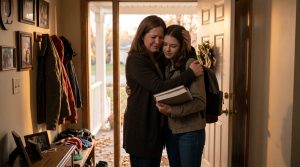
A car door closed out front. Footsteps hurried up the wooden walkway, and the front door swung open. Emily stood in the threshold, her backpack slung over one shoulder, a thick stack of biology textbooks balanced under her arm. Her face was weary, worn from lectures and late library hours, but her eyes were clear.
“Mom?” Emily asked, noticing Sarah standing in the entryway. “Are you okay? Did you finish clearing out Grandma’s room?”
Sarah looked at her daughter—so young, so full of untainted promise, standing on the threshold of a life her grandmother had bled to build.
Without a word, Sarah stepped forward and pulled Emily into her arms. She held her tightly, burying her face into Emily’s shoulder, feeling the steady, rhythmic beat of her daughter’s heart. Emily dropped the books onto the side table, wrapping her arms back around her mother, leaning into the embrace with quiet, instinctive comfort.
“Mom, what happened?” Emily whispered.
Sarah pulled back just enough to look into her daughter’s face, brushing a stray lock of hair behind Emily’s ear. The grief was still a jagged shard in her chest, but running alongside it was something immoveable—an overwhelming, sacred gratitude.
“Your grandmother left you a gift,” Sarah said, her voice steadying as she wiped away her tears. “She made sure your tuition was paid, sweetheart. All of it. Every single dime.”
Emily stared at her, her eyes widening in disbelief. “How? She didn’t have that kind of money…”
Sarah took a deep, shuddering breath, looking past Emily toward the front door, where the evening light settled across the yard.
“She made a way,” Sarah whispered, holding Emily’s hand in hers. “She gave you everything she had, so you would never have to bow your head to the world. Now, you’re going to finish that school, Emily. You’re going to walk across that stage. Because you’re carrying her name, and she cleared the whole road for you.”