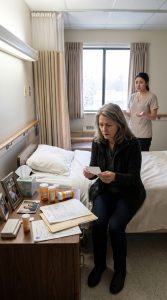
Every Sunday at precisely two in the afternoon, I would pull my aging sedan into the crowded, asphalt-cracked parking lot of Shady Pines Assisted Living. For three years, this was the unyielding tempo of my life. I would grab my worn purse, steady my breathing, and walk through the heavy glass doors that smelled eternally of lavender-scented disinfectant, lukewarm cabbage, and the sharp, institutional sting of rubbing alcohol.
And every Sunday, without fail, my mother was waiting.
She was usually in her favorite floral armchair by the window in her cramped, twelve-by-twelve room, her frail frame seeming to shrink a little more with every season. Her fingers, twisted by arthritis, would be resting on her lap, but the moment I stepped across the threshold, her tired face would light up with a smile that could cut through any gloom. “Oh, Heumy, my girl,” she would say, her voice paper-thin but rich with warmth.
“How are you, Mom?” I would ask, kissing her soft, wrinkled cheek. “How’s the food? Are they taking good care of you?”
“Everything is fine, sweetheart. Just fine,” she would reply, her hands patting mine. “The girls here are so sweet. They had music on Wednesday, and I have such a lovely view of the oak tree.”
She never complained. Not once. She didn’t complain about the lukewarm tea, the slow response times to the call button, or the echoing, nocturnal loneliness of the hallway when night fell. She was the model resident, always pleasant, always insisting she had exactly what she needed, even as her hands trembled whenever she tried to lift a glass of water.
Meanwhile, the reality of her care lived on my kitchen table at home, in the form of a monthly invoice: $8,200.
In America, aging is a luxury that few can truly afford, and we were always on the precipice of falling over. Between my job as a mid-level administrator, my husband’s fluctuating freelance income, and our daughter’s college tuition, that $8,200 a month was a crushing, suffocating weight. We had refinanced the house, dipped into retirement, and slashed our budget to the bone. Every invoice felt like a ticking clock, a reminder of the relentless cost of keeping a loved one safe and cared for. I was drowning, but I did it willingly, telling myself that as long as Mom was happy and safe, every penny was worth it. She was worth it.
I believed the medication—the expensive cocktail of cognitive and physical therapies they billed us extra for—was helping her. But last month, after she quietly passed away in her sleep, I was asked to clear out her small apartment. While packing her belongings into cardboard boxes, I stumbled upon a manila folder containing her medical and medication logs, tucked beneath some old crossword books in her bedside drawer.
My mouth went dry as I studied them.
The dates didn’t align. Some medication doses were documented as being administered full weeks after they should have been gone. Others were emptied far too fast, or marked with frantic, handwritten asterisks in the margins. It didn’t look like a schedule; it looked like a desperate, erratic attempt to stretch a supply.
I had cornered Elena, the young daytime aide who had been closest to Mom, in the hallway. Her eyes had darted to the floor, her hands twisting the clipboard she held, before she finally admitted the truth, her voice thick with tears. “She begged us not to tell you, Heumy. She’d wait until you left on Sundays, and then she’d hide the pills. She’d tell us she was taking them, but we found them in the tissue boxes, in the drawers. When we tried to force her, she’d cry and say she was just trying to save you some money, that she couldn’t let you lose your house because of her.”
That was when I understood the silence.
The tighter hand squeezes at the end of every visit, the way she would look past me at the window with a look of quiet, desperate resolve. She hadn’t been getting better; she had been rationing, hiding, and refusing her expensive therapies because she knew what it was costing us.
I went back to her empty room, sits in her vacant chair, and reached into the last unmarked cardboard box of her personal items. Right at the bottom, beneath her old shawls, was a prescription bottle, unlabeled and faded.
Taped to the underside was a tiny, folded piece of paper.
With trembling fingers, I unfolded it. Her shaky handwriting, written as her strength was failing, read: “I chose this so you could keep your house, my sweet girl. You carry too much on those shoulders. Please don’t be angry. I am not afraid, and I have had a beautiful life because of you. Let go of the worry now.”
Now, I sit in her empty chair every Sunday in my quiet living room, looking at the overgrown yard where she used to plant her petunias, clutching that faded scrap of paper. The bills have finally stopped coming, but the void left behind is heavier than any debt. I stare at the garden, the quiet house, and the silence, wondering if she knew how much I would have given—how much I would have happily lost—just to have had her stay, and if she ever understood that she was never, not for a single moment, a burden.