The bell above the door of Mel’s Country Kitchen gave its familiar, tinny chime as David stepped inside, the chill of a late November morning pressing in behind him. The air was thick with the scent of bacon, burnt coffee, and home fries—scents that had clung to his father, Earl, every morning for as long as David could remember.
It had been three days since Earl had passed away at eighty-two, quiet and unbothered, in the same small house he’d lived in since the 1970s. Since then, David had been moving through a haze of paperwork, phone calls, and memories. He had stopped by the diner not for a meal, but to pay whatever outstanding tab his dad might have left behind. Earl had spent his life as a mechanic, his hands permanently stained with motor oil, his wardrobe consisting of the exact same faded red-and-gray flannel shirt that he wore every day for the last nine years. David had always assumed his father was just barely scraping by, surviving on modest Social Security checks and the occasional odd job.
At the cash register, Martha, a waitress who had worked at Mel’s for nearly thirty years, stopped wiping down a pie case when she saw David. Her eyes instantly softened, filling with a sudden, heavy grief.
“Oh, David,” she whispered, her voice cracking. “We are so, so sorry. This place… it isn’t going to be the same without him.”
“Thanks, Martha,” David said, offering a tired, appreciative smile. “He loved this place. I actually wanted to see if he owed anything. I know he came in every single day.”
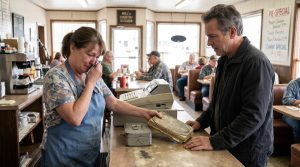
Martha didn’t answer right away. Instead, she reached for her apron, using the worn fabric to wipe away a tear that had escaped down her cheek. “Earl didn’t owe us a dime, honey,” she said. She reached under the counter and pulled out a thick, worn spiral notebook, its cover frayed and water-damaged, sliding it across the scuffed laminate toward him. “But there is something you need to see.”
David looked at the notebook, then back at Martha, confused.
“Your dad had a deal with us,” Martha said, her voice dropping to a gentle murmur. “He paid for every young mother who came through that door.”
David’s brow furrowed. “What do you mean?”
“For nine years,” Martha explained, “whenever a young mother came in with her kids—women who were clearly struggling, looking at the menu like they were counting pennies—Earl would catch my eye or Mel’s eye. He’d just nod. He’d say, ‘Put it on my tab, but don’t you dare tell them.’”
She reached under the counter again, lifting a heavy, scratched metal lockbox and placing it gently beside the notebook. “He left this behind the counter for us. He said if anything ever happened to him, I was to give it to you.”
David’s pulse thudded behind his temples. He reached out, his fingers brushing the cold, rusted metal of the lockbox, and then he opened the worn notebook.
Page after page was filled with Martha’s and Mel’s handwriting—dates, brief descriptions, and dollar amounts.“Oct 14 – young mom, two toddlers, pancakes & eggs – $18.40.”“Nov 3 – woman with baby, diaper bag, just coffee & oatmeal – $9.20.” Next to every single entry, in his father’s unmistakable, cramped handwriting, was a small checkmark and the word “Paid.”
As David flipped through the years, the numbers began to blur. The total, scrawled on the final completed page, was staggering for a man he thought had nothing: $3,400.
“He said he knew what it was like,” Martha said, her voice trembling as she rested a hand on David’s arm. “He told me once that when your mom passed back when you were little, he didn’t know how he was going to feed you. He said some stranger had bought him a meal in a diner once, and it was the first time he felt like he might actually survive. He promised himself if he ever got back on his feet, he’d pay it forward. He just… he didn’t want any credit. He said grace is best served quiet.”
David stared at the lockbox, his vision growing misty. He lifted the latch. Inside was a small stack of worn bills—fives, tens, and ones—accompanied by a handwritten note on a piece of scrap paper from Earl’s old garage.
 “David,” the note read in his father’s shaky handwriting. “If you’re reading this, I’m gone, and Martha’s given you the box. Don’t worry about the money—this is just what was left over from my old savings. It’s for the mothers. Keep the tab going as long as you can. A warm meal can change a life. Love, Dad.”
For a long moment, David couldn’t speak. The tiny, cluttered diner around him, with its clinking silverware and low chatter, suddenly felt like a sacred place. He had spent years worrying about his father’s frugality, wishing he could have given Earl a more comfortable life. But looking at the worn notebook and the cash in the box, David realized his father had lived the richest life possible.
David closed the notebook, a deep, comforting warmth blooming in his chest. “How much is left on the current tab, Martha?” he asked, his voice steadying.
Martha smiled through her tears. “We haven’t started a new page yet, David.”
David reached into his pocket, pulled out his wallet, and took out all the cash he had, placing it gently into the lockbox alongside his father’s savings. “Well,” he said, sliding the box and the notebook back toward Martha. “Let’s make sure we don’t miss anyone.”
As he walked out of Mel’s Country Kitchen, the cold air no longer felt quite as biting. The memory of his father’s faded flannel shirt didn’t feel like a symbol of struggle anymore—it was the armor of a quiet hero. David took a deep breath, looking down the bustling street of the small town, and for the first time since losing his father, he smiled, knowing that Earl’s quiet grace would keep this corner of the world warm for a long time to come.