The Key to Sarah’s Grace
The smell of damp wool, casket flowers, and rain-soaked earth had settled heavily into the chapel, but for Eleanor, the air was entirely frozen. In the front pew of the modest suburban church, she sat with her coat buttoned to her throat, her eyes fixed on the wooden casket that held her older sister, Grace.
For fifty-three years, Grace had been the steady, unmovable center of Eleanor’s world. While other sisters fought over toys or clothes, Grace and Eleanor had been forged in the dark. Their childhood had ended abruptly in 1978, the year their father died in a tragic mill accident, leaving them with an emotionally broken mother and a mounting pile of debt. Grace was fourteen. Eleanor was nine.
Even then, Grace had stepped into the breach, her small shoulders carrying burdens no teenager should have known. She made the dinners, handled the bill collectors at the door, and kept Eleanor shielded from the worst of the cold, hard world.
At the pulpit, Grace’s husband, Thomas, took the podium. His shoulders were bowed with grief as he looked out at the sparse gathering of family and neighbors. He cleared his throat, his hand trembling as he unfolded a piece of paper.
“Grace was many things,” Thomas said, his voice cracking. “A wife, a protector, a quiet soul. But before she was any of those things, she was a sister.”
He looked directly down at Eleanor, his eyes glistening.
“She wrote a poem, many years ago, that she never showed anyone but me. She wanted it read today. It’s titled: For the Sister Who Saved Me in 1978.“
Eleanor’s heart skipped a beat. 1978. The year they lost everything.
As Thomas read, the words painted a picture of two girls huddling in a drafty bedroom, holding hands as their mother wept downstairs. It was a beautiful, heartbreaking tribute to survival, but as Thomas finished, he didn’t return to his seat. Instead, he walked down the altar steps, straight to the front pew, and stood before Eleanor.
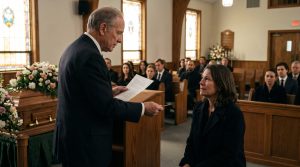 “She wanted you to have this,” Thomas said quietly, his hand extending. Resting in his palm was a small, vintage brass key, its head worn smooth by time. “She said you’d know what to do when the time came. Go to the First National Bank on Oak Street.”
Eleanor stared at the key, her fingers trembling as she took it. It felt impossibly heavy.
Two days later, the rain had stopped, but the grey Ohio sky still hung low. Eleanor sat in a small, private viewing room deep inside the subterranean vault of First National Bank on Oak Street.
The bank manager had politely let her in, sliding a long, metallic safety deposit box onto the worn table before quietly closing the door.
Eleanor sat alone, the heavy brass key fitting perfectly into the lock. With a soft click, the box opened, and as she lifted the lid, her breath caught.
Inside was money. Stacks of aged hundred-dollar bills, neatly banded, totaling $87,000.
But it wasn’t the money that made her knees weak. Beside the cash sat a bundle of seventeen greeting cards, spanning decades, postmarked and dated over the years. On top of the stack lay a hand-written note, the ink slightly faded, in Grace’s unmistakable, steady handwriting.
With trembling hands, Eleanor picked it up and began to read:
My dearest Ellie,
If you are reading this, it means I am no longer there to hold your hand, but I need you to understand. This is from the house I sold to pay for your college.
You never knew because I never wanted you to feel like a burden. I remembered how you cried when you got that acceptance letter, and how you almost tore it up because you knew we couldn’t afford the tuition. You were so smart, Ellie, so full of promise. I couldn’t let our father’s absence or this town’s poverty steal your future. So, I sold the small family house we inherited after Mom got sick, the one you thought the bank took. I rented an apartment, lived simply, and put every dime into your education, and the rest into this box for your own future.
I kept it a secret because I knew your proud heart. I knew you’d want to pay me back, or feel like you owed me your life. But you never did.
I did it because, in 1978, when Mom checked out and the world was too dark to bear, you were the only one who held my hand. You gave me a reason to wake up, to fight, and to be strong. You didn’t just survive with me, Ellie—your love saved me.
This is your grace. Use it to be free. I love you, always.
Your big sister, Grace.
Eleanor let out a ragged, choking sob, the tears finally breaking through as she pressed the paper to her face. For thirty years, she had carried a quiet, nagging guilt, believing she had been the lucky one who got to go to college and escape the old town, while Grace had stayed behind, working, sacrificing, and never complaining. She had always wondered how they had magically found the funds for her education, never questioning too deeply because she was too afraid of what the answer might be.
Now, the truth was here, in the quiet vault of a small-town bank, smelling of old paper and unconditional love.
Eleanor reached into the box, her fingers brushing the seventeen cards—each one a birthday, a graduation, a holiday, all containing small notes of encouragement from a sister who had spent her entire life being the shield between Eleanor and the dark.
As she sat in the dim light of the vault, clutching the note and the old brass key, Eleanor realized that she was not alone. Grace’s love hadn’t ended with her last breath; it was still here, shielding her, offering her a future she had never expected, and giving her the one thing she needed most: the absolute, unspoken certainty that she had never been a burden, only a beloved sister.
She closed her eyes, letting the tears fall freely, and whispered into the quiet room, “Thank you, Grace. I’ll make you proud.“
Below are the scenes capturing Eleanor’s journey—from the heavy, sorrowful moment of receiving the key to the heartbreaking revelation inside the bank’s vault.Let me know if you would like me to adjust any of these images or continue on with the narrative!