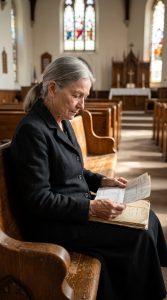
 Chapter One: The Familiar Bench
For fourteen years, Grace Vance’s life had been measured in small, predictable loops. Every Sunday morning, she would back her aging sedan out of the driveway of her modest home in Oakridge, Ohio, and drive the five minutes to Grace Community Church. It was a red-brick building with worn oak doors and a steeple that looked particularly beautiful against the backdrop of Midwestern autumn leaves.
She always sat in the fifth pew on the left. It had been “their” pew—hers and Arthur’s.
Arthur had been gone since 2012, taken by a sudden heart attack on a humid Tuesday in July. When he died, he left behind a house with a squeaky third step, a collection of vintage woodworking tools, and the kind of quiet void that never quite fills back up. In those early years, the grief was a heavy, physical presence sitting beside her on the worn cushions. Now, after fourteen years, it was more like a shadow—always there, but softer around the edges.
Lately, though, the Sunday services had felt longer. The hymns were the same, and Pastor Thomas’s sermons were as comforting as ever, but as Grace’s knees grew stiffer and the congregation became filled with faces she didn’t recognize, she felt her connection to the world fraying. The bustling, busy America she used to know was moving fast, while she remained anchored to the fifth pew, a relic of a different time.
Last Sunday, however, the routine broke.
As the congregation began to file out into the crisp, October air, Pastor Thomas had caught her eye and made a quiet, ushering gesture with his hand.
“Grace, do you have a few minutes?” he asked, his voice low and gentle, carrying the weight of a man who had guided this community through its deepest sorrows and greatest joys.
“Of course, Thomas,” she said, clutching her purse.
He led her to the small, book-lined study behind the altar, where the smell of old paper and coffee always lingered. He didn’t sit behind his desk; instead, he pulled up a chair close to hers and reached into his drawer. He produced a worn, expanding bank folder, its cardboard edges frayed and held together by an old elastic band that had lost its stretch.
“Arthur asked me to keep this for you,” Thomas said, placing the folder into her hands. “He wanted you to have this when… well, he said you’d know when the time was right, or I would. I think, Grace, with the years passing as they are, and the questions you’ve been asking about the past… it’s time.”
Grace looked down at the folder. Her name, Grace Vance, was written in Arthur’s familiar, blocky handwriting on the faded tab. “What is this, Thomas?”
“Just read it, Grace. He loved you fiercely. Never doubt that.”
Chapter Two: The Unraveling
Grace didn’t open the folder in the church. She couldn’t. She took it home, setting it on the kitchen table beside her untouched lunch. It sat there for hours, a quiet intruder in her silent house.
Only when the afternoon sun had begun to cast long, amber shadows across the linoleum did she finally sit down and slip the elastic band off.
Inside was a stack of bank statements from Oakridge National Bank, spanning over a decade, each one carefully folded and organized in chronological order. Grace’s fingers trembled as she pulled out the top sheet.
It was a transaction record from September 2011. There, highlighted in Arthur’s steady, blue ink, was an automatic monthly transfer.
$185.00.
Grace’s throat tightened. She looked at the next statement, and the next, and the one after that. Every single month, without fail, since the spring of 2011 until the very month Arthur passed away in 2012, $185 had been moved from their shared savings account to another account.
She remembered that year vividly. The economy was still recovering from the 2008 crash, and things had been incredibly tight. Arthur was working fewer hours at the hardware store, and she had been stretching every dollar, cutting coupons, and worrying about whether they could afford to help their grandson, Toby, with his community college textbooks. Seeing $185 a month—which was a significant amount of money for them back then—sent a sudden, sharp pang through her chest.
At first, a wave of confusion and hurt washed over her. Had he been hiding something from her? A debt? A secret?
But then her eyes drifted to the name on the receiving account. It wasn’t an unfamiliar business or an unknown name.
Clara Higgins.
Grace sat back, the breath leaving her in a quiet rush.
Clara. Her best friend from their Wednesday night Bible study.
Clara’s husband, Frank, had passed away from cancer in early 2011, just a year before Arthur. It was a devastating time for their small community. Clara had been left with mounting medical bills, a mortgage she could barely afford, and a teenage daughter, Lily, who was a brilliant student with dreams of going to the state university but no way to pay for it.
Grace remembered the hushed, tearful conversations she and Clara had over tea, Clara pouring her heart out about how she couldn’t bear to tell Lily that college might be out of reach. Grace had gone home and cried to Arthur about it, wishing they had the means to help, but knowing their own bank account was barely holding steady.
“We’ll pray for them, Grace,” Arthur had said back then, his hand warm on hers. “The Lord will find a way.”
Arthur had been the way.
He had quietly set up the transfer. For over a year, he had scraped together $185 a month—likely by taking on odd handyman jobs he never mentioned, or skipping his weekly lunches with the guys at the diner—and sent it directly to Clara to help pay for Lily’s tuition.
He had never said a word to Grace.
Because he knew I would have said we couldn’t afford it, Grace realized, a tear finally spilling over and landing on the faded paper.
She wouldn’t have been angry; she would have been terrified. She was the saver, the worrier, the one who looked at the electric bill with a furrowed brow. Arthur knew this. He had shielded her from the worry, and in doing so, he had quietly performed a miracle of grace for a friend in need.
Chapter Three: The Journey to Two Towns Over
As Grace dug deeper into the folder, she found a final piece of paper. It wasn’t a bank statement. It was a handwritten letter, dated just a few years ago, from Clara.
Clara had moved away three years after Arthur died, relocating to be closer to Lily, who had graduated, gotten married, and started a family of her own. Over the years, Grace and Clara had lost touch, the natural, slow drift of age and distance separating them.
The letter was addressed to the church, to be kept with the folder.
Dear Grace, the handwriting was shakier now, but unmistakable.
“If you are reading this, Thomas has finally given you the folder. I wanted to tell you so many times, but Arthur made me promise, on everything he held dear, that I would never say a word to you while he was here, and even after, he wanted you to only know when you were ready to see how much goodness he carried.
Your Arthur saved us, Grace. That money didn’t just pay Lily’s tuition; it kept our hope alive when we were drowning. Lily is a teacher now, and every day she walks into her classroom, I think of Arthur.
I am living in Dayton now, two towns over, with Lily and her beautiful children. I still drive back to Oakridge sometimes, just to leave flowers at Arthur’s grave when the seasons change. I leave them on the left side, where the ground gets the afternoon sun.
I miss you, my dear friend. I hope you can forgive my silence. And more than anything, I hope you will come see me. We have so much to talk about.”
Grace stared at the letter, her vision blurred by tears. The loneliness that had felt so heavy for the past fourteen years suddenly felt different—lighter, almost. Arthur hadn’t just left behind a squeaky step and some old tools. He had left a legacy of quiet, unsung generosity that had changed a young woman’s life.
She looked at the date on the letter, then at the address written carefully at the bottom. It was only an hour’s drive away.
Chapter Chapter Four: Grace
The next morning, the Ohio sky was a brilliant, endless blue. Grace didn’t sit in her living room. She didn’t look at the television or the dusty photo albums.
Instead, she put on her favorite dark jacket, the one Arthur always said made her eyes look bright, and got into her sedan. She stopped at the local florist first, buying two bouquets—one of deep red carnations, Arthur’s favorite, and one of yellow daisies, which Clara loved.
She drove to the Oakridge Cemetery first.
The grass was cool and dew-covered under her shoes as she walked through the familiar paths to Arthur’s headstone. There, on the left side, were the withered remains of a previous bouquet, long faded but placed there with care.
Grace knelt down, her knees protesting, and placed the fresh red carnations on the stone. She touched the cold granite, tracing his name.
“You old rogue,” she whispered, a tear slipping down her cheek, though this time she was smiling. “You always were too good for this world. Thank you.”
She sat there for a long time, the quiet of the cemetery feeling peaceful, no longer lonely.
When she finally stood, she felt a renewed strength in her legs. She walked back to her car, opened the passenger door, and looked at the yellow daisies resting on the seat.
She started the engine, put the car in drive, and set the GPS for the town of Dayton, two towns over. It was time to go see her friend. There was a lifetime of stories to catch up on, and Grace was finally ready to share them.
Title: The Hidden Tithe of Grace
This story reflects the enduring power of quiet generosity and the unexpected ways the past can return to heal the present, capturing the resilient spirit and deep-rooted community ties of life in small-town America.