The brass deadbolt on the front door had always turned with a heavy, unyielding click. Fourteen years ago, on a muggy July evening in Gary, Indiana, I drove down to the hardware store, bought a new lock cylinder, and installed it with hands shaking from rage.
My son, David, had turned eighteen that day. I had spent thirty-four years working the rolling mills of the steel plant, trading my hearing, my lumbar spine, and my youth so that my boy could have clean hands and a desk job. I had saved fifteen thousand dollars in a college fund—not enough to pay the whole freight of an engineering degree at Purdue, but enough to give him a running start without drowning in high-interest student debt.
Instead, David pushed the acceptance letter back across the table. He said he had joined a touring roots-rock band. He said college was a prison sentence for someone who lived for music.
“You think life is a concert?” I had roared at him, slamming my calloused palm onto the linoleum table. “Out there, nobody cares about your guitar! Rent doesn’t get paid with songs! If you walk out that door chasing a fantasy, you don’t come back to my roof when you’re starving.”
He didn’t scream back. He just picked up his battered canvas duffel bag and his grandfather’s Martin acoustic, walked down the gravel driveway, and didn’t look over his shoulder. That night, I changed the locks. I told myself it was tough love. I told myself he would come back within three months, hungry and humbled.
He never came back.
Every Thanksgiving, every Christmas, every Easter, when my sister and her kids gathered around my dining table, I set an extra porcelain plate, fork, and knife at the head of the table. Nobody ever asked who it was for. It sat there, glaring and cold, a monument to a father’s stubborn pride and an empty chair that felt heavier with each passing year.
Then, on a Tuesday afternoon three weeks ago, a cream-colored envelope arrived with an Austin, Texas return address.
Inside was a high school graduation announcement for Maya Healy—a girl with my late wife’s chin and David’s wide, dark eyes. On the back of the card, written in flowing blue ink, was a note from Sarah, the woman David had married twelve years ago, whom I had never met:
“She wants you there, Mark. But only if you’re ready to listen.”
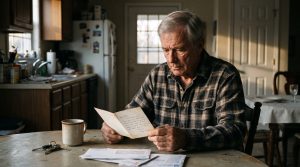
I sat at that same kitchen table for an hour, the paper trembling in my work-thickened fingers. My sister insisted I book a flight and apologize on my knees. My younger brother, a bitter veteran of his own family feuds, told me to throw it in the trash, saying some doors stay locked forever.
For nine sleepless nights, I stared at the ceiling fan. I wasn’t afraid of David cursing at me. I was terrified of walking into that auditorium, looking into the eyes of a grown man whose childhood I had severed with a five-dollar brass lock, and having to tell him that I had been wrong.
On the morning of the ceremony, I boarded a Southwest flight to Austin.
The auditorium was an overwhelming sea of blue robes, buzzing chatter, and the frantic clicking of smartphone cameras. I sat high up in the bleachers, clutching a simple bouquet of yellow daisies in my lap, feeling like a ghost trespassing in a world where he had no right to exist.
When Maya Healy’s name was called, a girl stepped onto the stage—tall, graceful, wearing a crimson cord of academic honors. She walked with the exact, unhurried posture of my wife, Martha. Down in the front row, a man stood up and cheered. He was lean, his dark hair threaded with silver, wearing a clean, fitted tweed vest over a crisp button-down shirt.
It was David.
 He looked healthy. He looked whole. He didn’t look like a man destroyed by the harsh reality I had so loudly promised would devour him.
After the caps were tossed into the rafters, the crowd spilled out onto the sunlit lawn outside the auditorium. Families gathered in tight circles, hugging and taking pictures against the backdrop of limestone pillars. I lingered beneath the shade of a live oak tree twenty yards away, my boots glued to the grass, my heart hammering against my ribs.
A voice spoke from behind me. “Mr. Healy?”
I turned. A woman in an emerald dress stood there, her eyes gentle, holding two iced coffees. Sarah.
“I wondered if you’d make it,” she said softly.
“I wasn’t sure I deserved to,” I choked out, the daisies suddenly feeling absurdly heavy in my arm.
She looked toward the center of the lawn, where David was laughing, pinning a corsage to his daughter’s gown. “David didn’t become a rock star, Mark. He played in bars for three years, worked warehouse shifts at night, and then went to community college while I finished nursing school. He’s the head of the music and audio production department at the regional arts high school now. He teaches kids who think the world doesn’t have room for them.”
She turned her gaze back to me. “He built a life out of harmony. But every single song he’s ever written has a silent beat in it. That beat is you.”
My throat closed. Sarah stepped forward, placed a warm hand on my shoulder, and turned toward the lawn. “David,” she called out gently.
David turned. His eyes scanned the grass until they locked onto mine.
The laughter faded from his face. For five agonizing seconds, the bustling noise of hundreds of celebrating families seemed to drop away entirely. Fourteen years of silence hung suspended between two men whose blood shared the same pulse.
He took a step forward. Then another. He walked toward the oak tree, his daughter trailing curiously behind him.
When he reached me, we stood three feet apart. He was taller than I remembered. Up close, I could see the lines etched around his eyes—the honest lines of a man who worked hard, loved deeply, and carried a private scar.
“Dad,” he said. The word was neither angry nor warm; it was simply a question.
I looked down at the bouquet of daisies, then up into the face of the boy I had turned away. The righteous anger that had fueled my stubbornness for over a decade collapsed into nothingness.
“I bought a new lock that night, David,” I whispered, my voice breaking like dry cedar. “I told myself I was teaching you how hard the world was. But the truth is… I was terrified. All I ever knew was the mill. All I ever knew was sweat, soot, and trading my body for a paycheck. When you wanted to make beauty, I didn’t understand it. And because I didn’t understand it, I tried to break it.”
A tear slipped through the wrinkles on my cheek, falling onto the collar of my Sunday jacket.
“I have set your plate at that table every single year, son,” I said, looking right into his eyes. “And every single year, that empty plate proved that I was a coward who couldn’t admit he was wrong. I am so sorry. I am so sorry I didn’t listen.”
David’s chest hitched. He looked at Maya, who stood beside him, watching with wide, understanding eyes. Then he looked back at me. He didn’t offer a theatrical speech, and he didn’t pretend the lost fourteen years had never vanished into the dark.
Instead, he reached out, took the clumsy bunch of daisies from my hands, and pulled me into his arms.
His grip was firm, smelling of cedarwood cologne and warm Texas sun. I buried my face in his shoulder, feeling the solid, living reality of my son, and for the first time in fourteen years, the knot of steel in my chest let go.
“Maya,” David said, stepping back slightly while keeping an arm around my shoulders, his eyes damp. “I’d like you to meet your grandfather.”
Maya smiled—the radiant, wholehearted smile of a girl who knew she was unconditionally loved—and stepped forward to wrap her arms around my waist.
Later that evening, sitting at a noisy Tex-Mex diner surrounded by paper napkins, laughter, and a girl chattering about her freshman dorm, David looked across the booth at me.
“You still setting that plate, Dad?” he asked quietly.
I swallowed a mouthful of water, smiling through misty eyes. “Not anymore. Next Thanksgiving, someone’s actually going to have to eat from it.”