The clock on the mantelpiece in the living room of the small, cedar-shingled ranch house on Elm Street ticks with a heavy, metallic finality. Every swing of the pendulum feels like a step toward a reckoning I’ve spent fifteen years trying to survive.
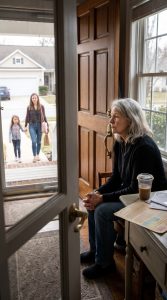
I’m sixty-seven years old, with hands that are worn and silver-gray hair that I’ve stopped trying to dye. I’m sitting on the edge of the entry bench, staring at the solid oak door. Beside me on the console table is a paper cup of coffee that went entirely cold hours ago. Tucked beneath my fingers is a manila envelope containing four printed sheets from the Summit County School District—the counselor’s reports I had angrily dismissed as exaggerations back in the autumn of 2011.
Outside, a light October rain is tapping against the glass of the storm door, casting blur patterns over the gravel driveway where a small car has just parked.
In ten minutes, they will walk up the steps, and my daughter will knock. And I will have to decide if I can find the words that might finally mend the fracture, or if the damage from that terrible night is permanent, no matter what I do.
In the blue-collar suburbs of Ohio, where the winters are long and everyone’s grandfather worked a shift at the rubber plants, “family” is a fortress. You protect it from the outside, and you protect it from itself. Back in 2011, my fortress was already fraying at the edges, but I had refused to see the cracks.
I was working forty-eight hours a week at the hospital’s billing office, my husband had been gone five years, and my two children were the center of my frantic, exhausted world. There was Robert, my nineteen-year-old—big, charismatic, and volatile, a boy who had always carried a kind of dark, simmering frustration that I had written off as “teenage rebellion.” And then there was Chloe, seventeen—quiet, watchful, and increasingly withdrawn, always hiding beneath oversized hoodies and keeping to her room.
The tension between them had build like a slow-burning fire in a damp basement. Chloe began accusing Robert of things that didn’t make sense to me. “He’s angry, Mom. He hits the walls. He doesn’t let me leave the room.”
I had believed Robert when he told me she was “making things up for attention” because she was jealous of his friends and his job at the auto shop. He was my eldest, my protector, the one who took out the trash and helped with the oil changes. Chloe’s frantic, tearful pleas felt to my exhausted mind like an attack on the delicate peace I had fought so hard to maintain. To admit Robert had a darkness inside meant admitting that my home was unsafe, that my fatherhood had failed, and that the world had already won.
The tipping point came on a freezing Thursday night in November.
Chloe had come home from her after-school job, her face pale, her eyes wild with a panic that seemed entirely out of proportion. She demanded we call the police, claiming Robert had cornered her in the hallway, grabbing her arm so hard it had bruised, screaming because she had “looked through his things.”
I had looked at Robert, who stood behind the kitchen counter with his hands in his pockets, his shoulders hunched in a posture of injured innocence. “She’s trying to ruin my life, Mom,” he had pleaded. “I barely touched her. She’s trying to get me locked up.”
I had broken.
The fear of what a police report would do to Robert’s future, the terror of public shame in a small town, and the sheer, bone-deep exhaustion of navigating their constant, venomous wars finally overwhelmed my judgment. I turned on my daughter with a cold, unforgiving fury that makes my throat tighten with shame even now.
“I am tired of the lies, Chloe,” I had shouted, my voice bouncing off the laminate counters. “I am tired of you trying to destroy this family. It’s him or you. You can’t keep living here if you’re going to act like a victim every time your brother loses his temper. If you can’t respect this house, you can leave.”
I had expected tears. I had expected the familiar slam of her bedroom door, perhaps a week of stony silence.
Instead, Chloe had simply looked at me, her hazel-gold eyes empty, as though she were seeing a stranger. “Okay,” she said.
She had gone to her room, packed a single duffel bag, and walked out into the freezing November rain. And in my stubborn, self-righteous panic, I had gone to the hardware store the next morning, bought a deadbolt, and changed the locks on the front door, telling myself I was “protecting the house.”
The locks had stayed. Chloe had not returned.
Over the next fifteen years, my fortress collapsed anyway. Robert’s volatility didn’t fade; it grew, eventually landing him in a county jail on assault charges that I could no longer ignore or explain away. The “family” I had sacrificed my daughter to protect proved to be built on sand, while Chloe had vanished into the vast, indifferent landscape of the Midwest, entirely lost to me.
Every Thanksgiving and Christmas, I set her place at the table—fork on the left, knife and spoon on the right, an empty blue ceramic plate that gathered dust while I ate my meals alone in front of a flickering television. The plate was an altar to my own stubborn stupidity, a silent daily confession that my pride had driven my own child out into the dark.
Then, last week, an email arrived from an old school district account—the school counselor, Mrs. Henderson, who had retired years ago.
She had been cleaning out her personal files and had found a series of documented reports from Chloe’s junior and senior years that had never been fully processed or had been buried in the administrative bureaucracy. Attached were scans of handwritten notes and photographs: Chloe’s arms, marked with heavy, hand-shaped bruises. Four separate times. The counselor had try to contact me back then, but in my defensive, fearful panic, I had ignored the letters, writing them off as “interventionist nonsense.”
Staring at those grainy, digitized photographs, my coffee went cold. The bruises weren’t “teenage drama.” They were the visible, undeniable proof of a daughter who had been terrorized in her own home, while her mother had bought a lock to keep her from telling the truth.
The letter had arrived yesterday.
It was a brief, hesitant note, written in Chloe’s now-adult hand: “I’m coming to Ohio next month to see some old friends. I have a daughter now. Her name is Lily. I want her to see where I grew up, if that’s okay with you. We can stop by on Saturday morning.”
The sound of footsteps on the porch steps breaks the reverie.
I stand up, my knees stiff and aching, and pull back the sheer curtain of the small window beside the door. Through the glass, blurring by the drizzle, I see them.
My daughter, Chloe, now thirty-two, wearing a dark coat, her shoulders slightly hunched against the chill. Her hair is cut shorter, and she carries herself with a quiet, grounded strength that makes her look entirely different from the frightened teenager who left fifteen years ago. And beside her, holding her hand, is a little girl—around six or seven years old—with messy brown hair, wearing a pink jacket and carrying a small bag. She has Chloe’s exact eyes, the hazel-gold eyes that I had refused to look into on that terrible November night.
My hand goes to the deadbolt—the deadbolt I had installed fifteen years ago to keep my daughter out.
I turn the lock. The metallic click feels like a shotgun blast in the quiet hallway.
I push the heavy oak door open.
Chloe stops on the welcome mat. The little girl, Lily, peeks out from behind her mother’s coat, her curiosity warring with shyness. For a long, agonizing second, neither of us moves. The fifteen years of silence, the missed birthdays, the unaddressed pain, and the heavy, unforgiving weight of my choice hang in the cool air between us like a physical barrier.
“Mom,” Chloe says. Her voice is deeper than I remember, but the cadence is unmistakably her own. She doesn’t step forward; she doesn’t offer a hug. She simply stands there, watchful, waiting to see if the locks have truly been changed.
I feel the tears finally breaking, hot and sharp against my weathered cheeks. I look past her to the little girl, then back to my daughter, and I let the pride that has choked my life for fifteen years finally go.
“Chloe,” I whisper, my voice cracking in the autumn air. “I was wrong. I was so damn terrified of my own failures that I lock the door on the one person who needed me to open it. I saw the counselor’s reports. I saw what I did to you. There hasn’t been a single day in fifteen years where I didn’t regret that night.”
A small muscle jumps in Chloe’s cheek. She looks down at her daughter, then back at me, her jaw softening ever so slightly as she takes in the sight of her aging, broken mother kneeling on the entryway bench.
“It was a very long time ago, Mom,” Chloe says quietly, her words steady and stripped of the old venom, though the hurt is still there, a faint scar on the surface of her voice. “But I wanted Lily to know her grandmother.”
She takes a slow, hesitant step across the threshold, pulling her daughter with her.
As the door closes behind them, shutting out the October chill, the small ranch house on Elm Street doesn’t suddenly fill with easy forgiveness. There is still a vast, difficult terrain of healing we will have to traverse, and the damage of that night will always be a part of our history. But as my trembling hand meets my daughter’s shoulder—warm, real, and entirely forgiving—I know that the locks have finally been undone, and the empty plate at the Thanksgiving table has finally found its purpose.