The echo of the door slam from seven years ago still seemed to reverberate through the quiet corners of Marilyn Vance’s home. On that cold, bitter evening, her son, Jared, had stood in her hallway, eyes blazing with a mixture of desperate hurt and fierce anger. He had married Brenda—a woman Marilyn believed was entirely wrong for him, a quick match made in the chaotic rush of their early twenties—against Marilyn’s vocal, unyielding wishes.
When Jared came back a year later, swallow-hard and humble, asking for a $1,200 loan to fix their broken furnace during a brutal Midwest winter, Marilyn had let her pride do the talking. “You made your bed, Jared,” she’d said, her voice like ice. “If you had listened to me, you wouldn’t be begging for scrap now.”
He had looked at her then, his face hardening in a way that made him look decades older. “You love your pride more than you love your own blood,” he had shouted, his voice cracking before he turned and slammed the front door.
Marilyn had believed, with the stubborn certainty of a woman used to having the last word, that he would eventually come around. But the days turned to months, the months to years, and the silence only grew heavier. She had never answered his few tentative calls in the beginning, and soon enough, those calls stopped altogether. For seven years, the house remained dead quiet. Marilyn lived her life in a self-imposed fortress, telling herself she had been right, but as the seasons blurred, the empty rooms became more of a prison than a sanctuary.
That silence shattered on a drizzly, freezing Thursday afternoon.
Marilyn was in the kitchen, half-heartedly rinsing a coffee mug, when she heard the faint, uneven knock on the heavy oak front door. It wasn’t the assertive wrap of a delivery driver or the familiar, energetic pound of a neighbor. It was low, tentative, almost hesitant.
Frowning, she wiped her hands on a dishtowel and walked down the hallway, the hardwood floor cold beneath her socks. When she pulled the door open, she didn’t see an adult.
Standing on her porch, shivering slightly under the gray, overcast sky, was a boy about seven years old. He wore a worn, slightly oversized winter coat with a fraying zipper, and a tattered, muddy backpack hung loose from one shoulder. In his small, gloved hands, he clutched a crumpled, colorful piece of paper.
“Hello?” Marilyn said, her voice cautious, her eyes searching the empty street behind him. The neighborhood was quiet, save for the distant rumble of a passing truck. “Are you lost, sweetheart? Where is your—”
The boy looked up, and the words died in Marilyn’s throat.
The child had Jared’s exact face. He had the same slight, cowlicked brown hair, the same shape of the jaw, and most piercing of all, the exact deep green gaze that had once looked at her with so much warmth—and later, so much anger.
“Are you Marilyn?” the boy asked, his voice barely a whisper, a tiny puff of visible breath fading in the cold air.
Marilyn felt her heart give a violent, erratic thud. She stepped onto the threshold, her hand gripping the doorframe. “Yes… yes, I am. Who are you?”
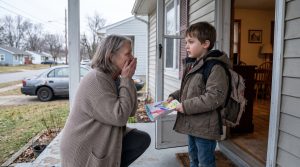 Instead of answering directly, the boy held out the paper he had been clutching. It was a child’s crayon drawing, folded and worn at the edges. Marilyn’s hands shook as she took it. On the paper was a drawing of an older woman with gray hair, holding a tiny, bundled baby boy. At the top, in uneven, child’s handwriting, it read: ME AND GRANDMA.
Marilyn’s knees gave way against the baseboard, and she sank to her knees right there on the porch, the rough wood pressing through her pants. “Who… who gave you this?” she whispered, tears blurring her vision as she looked at the child.
The boy looked directly into her eyes, his lip trembling just slightly. “My name is Toby,” he said, his voice small but steady. “Mom said… she said if we ever lost Daddy, I was to bring you this, and tell you…” He swallowed hard, a tear finally escaping his eye and tracing a path down his wind-chapped cheek. “…tell you that he loved you, and that we need help.”
The world seemed to spin on its axis. “Lost Daddy?” Marilyn managed to ask, her hand flying to her mouth as the crushing, horrible realization began to take shape in her chest. “Toby… where is your dad?”
“He died last week,” Toby said quietly, his gaze dropping to his worn sneakers. “He was working on the highway, and… a car didn’t see him. Mom says he’s in heaven now. She’s… she’s really sick, and the apartment is really cold because the heater broke again, and she said we didn’t have anywhere else to go.”
Marilyn let out a ragged, choked sob, the seven years of pride and stubbornness evaporating in a single, agonizing instant, leaving only the raw, bleeding truth of what she had lost. Jared was gone. Her son, whom she had carried, whom she had loved, whom she had shut out, was gone. And here was his boy, standing on her porch, a living testament to the love and life she had refused to acknowledge.
“Oh, sweetheart,” Marilyn gasped, her arms reaching out.
Toby hesitated for only a second before stepping forward, letting his small, heavy frame fall into her embrace. Marilyn held him tight, the worn fabric of his winter coat pressing against her, her tears soaking into his collar. She held him as if she could hold onto the son she would never see again, as if she could squeeze the seven years of wasted, foolish time out of the cold air.
The days that followed were a blur of grief, action, and the slow, painful dismantling of old walls. Marilyn went with Toby to the tiny, dilapidated apartment on the other side of the county, where she finally met Brenda.
There were no shouting matches, no proud declarations. Brenda was exhausted, pale with the dual burden of grief and an untreated illness, her eyes red-rimmed but defiant as she sat in the drafty living room.
“I didn’t want to come here, Marilyn,” Brenda said, her voice raspy. “Jared… Jared never wanted to ask you for anything again. But he always kept that drawing Toby made when he was four. He’d tell Toby stories about how you used to make giant breakfasts on Saturdays. When Jared… when he was killed, I realized I couldn’t do this alone. I’m not well, and I have nothing. I didn’t want my pride to ruin Toby’s life the way…” She trailed off, but she didn’t need to finish the sentence.
“I know,” Marilyn said, her head bowed, her hand resting on the worn kitchen table. “I know. And I’m so sorry. I spent seven years being right, Brenda, and it got me nothing but an empty house.”
Marilyn helped Brenda pack up their few belongings. Within a week, Brenda and Toby were moved into the spacious, once-quiet house on the hill. The broken furnace was no longer an issue; Marilyn paid for the repairs on the apartment, then simply brought them home to a place where the heat was always on.
It wasn’t an easy transition. The grief of Jared’s loss hung over them like a heavy shroud, and the years of estrangement couldn’t be healed with a few apology words. But as the winter nights closed in, the house was no longer dead quiet. There was the sound of Toby’s footsteps on the stairs, the low murmur of Brenda and Marilyn talking over dinner, and the faint, chaotic noise of a child’s cartoons in the living room.
One evening, Marilyn sat at the kitchen table, watching Toby color a new picture at the counter while Brenda rested on the sofa. Toby looked up, his green eyes catching the warm light of the kitchen.
“Grandma?” he asked. “Are you going to stay with us?”
Marilyn walked over, resting a hand gently on his shoulder, feeling the solid, precious reality of the family she had almost lost forever.
“I’m never going anywhere, Toby,” she said, her voice soft but fierce with a promise she would never break. “Never again.”
The silence was finally, truly gone, replaced by the difficult, beautiful work of starting over. The price had been immeasurable, but on this night, the warmth in the house was real, and the door was wide open.