 Chapter One: The Phantom Girl next Door
For twenty-four years, the silence between Sarah Jenkins and her younger sister, Amanda, had been a cold, impenetrable wall. It began in the humid Ohio summer of 2002—a furious, bridge-burning shouting match on their parents’ porch, fueled by betrayal, messy secrets, and the wreckage of a shared life. Amanda had packed her car and vanished into the night, and Sarah, wounded and fiercely stubborn, had changed her phone number, cut ties, and vow to never look back. Over the years, Sarah built a stable, quiet life in their suburban Dayton neighborhood, occasionally hearing rumors that Amanda had moved out of state, but never care to confirm.
Until last week, when the moving truck arrived next door.
The new neighbors were the Gills—an older couple, Mark and Nancy, who had relocated from Michigan to be closer to Nancy’s sister. Helping them unload was their twenty-four-year-old daughter, Chloe.
Sarah was on her front porch watering her ferns when she first saw the girl. Chloe was carrying a box of books, laughing at something her father had said.
The sound of that laugh made Sarah’s heart skip a beat. It wasn’t just a pleasant sound—it was a sudden, jarring echo of Amanda. It was a throatier, uninhibited laugh that Sarah hadn’t heard in two decades, yet recognized in her bones.
Then Chloe turned and saw Sarah. “Hi there!” she called out, offering a bright, effortless wave.
Sarah’s breath caught. The girl had Amanda’s eyes—the slight, hazel tilt, the expressive, crinkled corners. It was like looking at a ghost from 2002. Sarah managed a weak wave back, her stomach dropping into a cold, dizzying void. It can’t be, she told herself, trying to shake the impossible thought. It’s just a coincidence. People look like people.
But the resemblance lingered like a shadow over the next few days.
During the neighborhood block party on Saturday, the community gathered around folding tables, sharing potato salad and casual chatter. Chloe was there, energetic and outgoing, talking with a group near the grill about a blood drive she’d helped organize back in her college town.
“I have O-negative,” one neighbor said. “Universal, right?”
“Lucky you!” Chloe had laughed. “I’m AB-negative. Super rare, apparently. I always joke that it means I’m a universal receiver, but only if it’s incredibly specific.”
Sarah, holding a paper plate nearby, froze.
AB-negative was exceedingly rare—less than one percent of the population. But it was Sarah’s blood type. It had also been her late father’s blood type. Amanda’s, however, was A-positive.
That night, Sarah couldn’t sleep. The ticking clock in her living room sounded like a countdown. She kept seeing the girl’s eyes, hearing her laugh, and remembering the messy, traumatic timeline of 2002. Back then, Amanda had been pregnant—a high-stakes, stressful secret that had been the catalyst for their final blowout. Amanda had claimed she was going to have the baby and figure it out, but weeks after she left, she had sent their mother a brief, devastating letter: the baby, a girl, had died during a difficult, premature delivery in Michigan, and Amanda wanted to be left alone to grieve.
A dead baby. A girl who would have been twenty-four today.
Chapter Two: Unearthing the Past
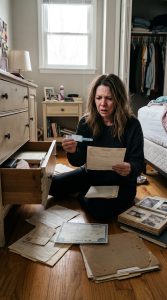
On Sunday morning, the house was entirely quiet, the pale Ohio sunlight filtering through the blinds. Obsessed with the nagging, impossible math, Sarah went to the spare bedroom and began to dig. She pulled out the heavy, cedar chest where she kept old family documents, her knees pressing against the worn carpet as she rummaged through yellowed folders, high school yearbooks, and tax returns.
Deep in the back, inside a worn paper envelope from their childhood home, she found a plastic baby box containing old sentimental trinkets.
At the bottom lay her own tiny, faded hospital bracelet from 1978. Printed on the worn blue plastic was BABY GIRL JENKINS, alongside her birth date and her blood type: AB-.
Beside it was a handful of Amanda’s old high school medical records, their father’s military files, and—crucially—a copy of Amanda’s hospital release forms from 2002, which had been mailed to their mother during the brief, chaotic aftermath of the family split.
Sarah’s hands began to tremble as she stared at the dates.
According to Amanda’s frantic letters back then, the baby had died in April 2002 at a hospital in Detroit. But as Sarah sat on the floor, looking at the timeline, something didn’t add up. She remember their mother, distraught and weeping, talking about how Amanda had refused to let anyone come up to Michigan, saying the grief was too heavy, that they had buried the baby in a small, private plot.
But just yesterday, Nancy Gill had mentioned to a neighbor at the block party that they had adopted Chloe as an infant in Michigan.
“She’s our miracle,” Nancy had said warmly. “We were on the waitlist forever, and then, in the spring of 2002, we got the call. A young woman in Detroit wanted a closed adoption. We never met the biological mother, but we always pray for her. In fact, Chloe knows she’s adopted—it’s never been a secret.”
The spring of 2002. Detroit.
Sarah sat on the hardwood floor for an hour, the faded papers scattered around her like pieces of a broken mirror. Her chest felt tight, the air in the room suddenly scarce.
Amanda hadn’t lost the baby. She had given her up.
The lie about the baby’s death hadn’t been out of malice, Sarah realized with a sudden, crushing wave of empathy. It had been out of sheer, overwhelming desperation. In 2002, Amanda was twenty, broke, estranged from her sister, and completely terrified. She had chosen a closed adoption to give her daughter a better life, but the guilt and shame of “giving away” a child in their traditional, judgmental family must have been too much to bear. She had told the easiest, most final lie she could think of to stop the questions: the baby died.
The thought was heartbreaking, but it led Sarah to a deeper, more chilling realization.
The blood type. AB-negative is hereditary. If Chloe was indeed Amanda’s daughter, she would have needed to inherit that rare type. Amanda was A-positive. For Chloe to be AB-negative, the biological father had to carry the B gene, and likely the rare negative factor.
In 2002, Amanda had been seeing two men. There was her on-and-off boyfriend, a local mechanic named Derek, who had B-positive blood. And then there was David—Sarah’s ex-fiancé, the man whose brief, secret affair with Amanda had been the very reason Sarah had walked away, changing her number and cutting them both out of her life forever.
David had been AB-negative.
Sarah closed her eyes, the truth hitting her like a physical blow. The child wasn’t just her niece; she was the living, breathing result of the betrayal that had shattered her family twenty-four years ago. No wonder Amanda had fled, and no wonder she had lied. The truth would have destroyed what little was left of their family.
Chapter Three: The Cemetery on the Hill
The weight of the secret sat heavily on Sarah’s shoulders all week. She watched Chloe from her window—the way she carried herself, the way she jogged down the street, her ponytail bouncing just like Amanda’s used to.
She needed to know the truth, but more than that, she needed to find Amanda.
On Friday, Sarah got into her car and drove the three hours north to the small Michigan town where Amanda had reportedly lived years ago, guided by a address she had quietly found through an online search. Her heart pounded as the miles ticked away, the flat Ohio landscape giving way to the rolling hills of southern Michigan.
Eventually, she arrived at the address—a modest, slightly weathered ranch-style house on the outskirts of a small town.
Sarah parked across the street, her hands gripping the steering wheel. What was she going to say? How do you re-enter a sister’s life after twenty-four years, armed with the knowledge that the daughter she thought was dead—or had given up—was living next door?
Before she could muster the courage to get out, she saw a woman walk out of the front door.
It was Amanda.
She was older now, her hair touched with gray, wearing a faded cardigan as she carried a watering can to the porch plants. Her movements were slower, heavier, but she was unmistakably her sister.
Sarah’s breath caught in her throat. The anger that had fueled her for twenty-four years suddenly evaporated, replaced by a profound, aching grief for all the lost time, all the unshared burdens.
She opened the car door and stepped out into the cool, afternoon air.
Amanda turned at the sound of the car door, her brow furrowing as she saw a stranger approaching. But as Sarah drew closer, Amanda’s watering can slowed, then stopped.
“Sarah?” Amanda’s voice was barely a whisper, disbelieving, her hand rising to her mouth.
“Hi, Amanda,” Sarah said, her voice shaking.
For a long, agonizing moment, neither woman moved. Then, with a choked sob, Amanda closed the distance, her arms wrapping tightly around Sarah. Sarah held her sister back, the years of icy distance melting away in the warmth of the embrace.
They sat on Amanda’s porch, the evening shadows lengthening as they spoke. At first, it was hesitant—updates on their mother’s passing, quiet admissions of regret. But then, Sarah took a deep breath.
“Amanda,” Sarah said gently. “I need to ask you about 2002. About the baby.”
Amanda’s entire posture went rigid. She looked away, her eyes filling with tears. “Sarah, please… it was the hardest thing I ever did. I was so scared. You guys were so angry with me, and I couldn’t face the judgment. I couldn’t keep her, Sarah. I didn’t have any money, I didn’t have anyone. I gave her to a agency in Detroit. A closed adoption.”
“I know,” Sarah said, placing a gentle hand on Amanda’s arm. “But you told Mom she died.”
“I was ashamed,” Amanda whispered, her voice cracking. “I felt like a failure. Telling everyone she was gone… it was the only way I could survive the guilt. But I never stopped thinking about her. Every April, on her birthday, I go to a small memorial park nearby, just to sit and think about her. I cry, Sarah. I cry every year.”
Sarah squeezed Amanda’s hand, her eyes tearful. “She didn’t die, Amanda. She is alive. And she is happy.”
Amanda’s head snapped up, her eyes wide with a mix of terror and hope. “What? How do you know?”
“Because she just moved in next door to me in Dayton,” Sarah said. “Her name is Chloe. She has your eyes, Amanda. And she has your laugh.”
Amanda gasped, a hand flying to her chest. “Next door? To you? How… how is that possible?”
“It’s her,” Sarah said softly. “The Gills adopted her in Michigan in 2002. They moved to Ohio last week. It’s a miracle, Amanda. Or maybe it’s just the universe giving us a second chance.”
“Does she know?” Amanda’s voice was a frantic, desperate whisper.
“She knows she’s adopted,” Sarah said. “But she doesn’t know you. Not yet. But we can change that. If you’re ready.”
Chapter Four: Bridges Rebuilt
A month later, the Dayton neighborhood was covered in a light dusting of late autumn frost.
In Sarah’s dining room, the table was set for a family dinner. Amanda had come to stay for the weekend, her first visit to Sarah’s house in over two decades. The air was filled with the warm, comforting scent of roasting chicken and rosemary.
Through the dining room window, Sarah watched as the Gills’ front door opened. Chloe walked out, wearing a dark winter coat, carrying a covered dish. She had been invited over for what she thought was a casual neighborhood dinner.
Inside, Amanda stood near the hallway, her hands trembling, her eyes fixed on the door.
“Are you ready?” Sarah asked, walking over to stand beside her sister.
“I’ve been waiting twenty-four years for this,” Amanda said, her voice shaking, but her gaze steady.
The doorbell rang.
Sarah opened the door, and Chloe stepped inside, her face lit up with a warm, familiar smile. “Hi, Sarah! I brought some of my mom’s—”
Chloe stopped, her eyes landing on the woman standing in the hallway. She looked from Amanda, with her hazel eyes and the silver-streaked hair, back to Sarah, and then back to Amanda. There was a moment of profound, unspoken recognition, a sudden, electric stillness in the warm room.
Amanda took a small, hesitant step forward, her eyes brimming with tears. “Hi, Chloe.”
As Chloe’s brow furrowed, her expression shifting from curiosity to a sudden, emotional realization, Sarah quietly stepped back, joining Nancy and Mark Gill who had just arrived behind Chloe, their faces filled with quiet, supportive understanding.
The wall of silence had finally crumbled, and in its place, a new, complicated, and beautiful family was beginning to build.
Title: Bloodlines of the Heartland
This story captures the painful complexities of family secrets, the burden of past betrayies, and the unexpected ways the truth can return to offer healing and reconciliation in everyday American life.