The basement corridors of St. Jude’s Memorial Hospital never experienced dawn or dusk, only the constant hum of industrial ventilation and the sterile glare of recessed fluorescent strips. For nineteen years, I clocked in at 11:00 PM as a night-shift pharmacy technician. In an industrial pocket of western Pennsylvania where manufacturing jobs had vanished decades ago, a union-backed hospital post was something you protected with absolute discretion. I was a man who kept his head down, filled automated medication carousels, verified barcoded serial numbers, and signed off on delivery logs. I believed that staying within the lines was enough to live an honorable life.
That illusion came apart on a humid Tuesday at 3:15 AM.
The subterranean dispensing floor was desolate when Helen, the clinical directress of the fourth-floor oncology wing, pushed open the heavy magnetic security door. Helen had spent nearly thirty years climbing the hospital’s hierarchy. She possessed an imposing, unyielding demeanor that made junior residents avert their eyes in the elevators. She walked straight toward the automated dispensing vault where I was running the 0300 inventory scan.
She did not greet me. Instead, she boxed me against the steel frame of the narcotic carousel, thrusting a dense stack of pink paper requisitions into my chest. Underneath them sat a heavy bank envelope secured with two thick rubber bands.
“Log the narcotics on these slips as spilled during transit, Thomas,” she whispered, her voice low and tight, devoid of hesitation. “Enter them into the disposal protocol, override the digital prompt, and shred every physical verification slip before the seven o’clock supervisor logs on. There’s twenty-two thousand dollars in that envelope. Cash. Take it, keep your mouth shut, and do your job.”
 The sheer audacity of the demand left me breathless. Blood hammered against my temples. In a town where average household incomes hovered under forty-five thousand dollars, twenty-two thousand was a life-altering sum. It could replace the sputtering transmission on my pickup, pay down the balance on my wife’s diabetic supplies, and keep the furnace running through the coming winter.
“Helen, this volume… you can’t report this many shattered ampoules without an audit trigger,” I stammered, looking down at the paperwork.
“I handle the floor audits,” she said coldly, tapping the pink carbon copies. “You just push the keys. You’ve been here nineteen years, Thomas. You know what happens to techs who start asking administrative questions. Don’t make this complicated.”
She turned on her rubber soles and slipped out into the stairwell, leaving the envelope and the slips on my prep table.
My hands shook as I picked up the stack. They were not routine surgical stock or trauma requisitions. Every single order had been pulled for Bed 401 through 420: Fourth Floor Oncology.
A knot tightened in my gut. Over the past five months, I had heard the quiet whispers among the floating night nurses during their cafeteria breaks. They had talked about how hard the terminal patients on four were having it—how elderly men and women with end-stage bone metastases and pancreatic malignancies were screaming into their pillows, completely unresponsive to maximal intravenous morphine titrations. The treating oncologists had assumed tolerance or rapid disease progression, doubling doses while families watched their loved ones writhe in torment.
I did not shred the paperwork. Instead, I locked the cash envelope in my personal metal locker and sat in front of the main terminal. Over the next three hours, I leveraged my system credentials to pull the computerized dosage audits for the fourth floor spanning the last six months.
The digital trail laid out an unspeakable reality.
Helen had not merely pocketed surplus inventory. She had developed a systematic method of tampering: drawing high-concentration injectable morphine from unopened glass vials using micro-gauge needles, refilling the exact displaced volume with bacteriostatic sterile saline, and sealing the rubber stoppers with adhesive film before placing them back onto the ward’s automated dispensing trays. For months, dying patients had been receiving pure saltwater while their bodies buckled under agonizing, unmedicated pain.
As I scrolled down the electronic diversion logs, my eyes locked on the digital authorization field. To bypass systemic pharmacy locks for controlled narcotics, every transaction required dual authorization. Next to Helen’s employee credential was the second required digital signature: Dr. Gregory Ross, the hospital’s associate chief of palliative care and an active member of the hospital’s executive foundation board.
Every single diversion slip bore his encrypted sign-off.
The weight of the room pressed down on my chest like lead. This was not the desperate act of an isolated addict; it was an organized ring running right under the nose of corporate risk management. In American healthcare, where liability and public relations dictate executive decisions, an hourly worker accusing a prominent board physician and a decorated head nurse of criminal enterprise faced near-certain professional ruin. I knew the corporate machine: internal investigations had a way of disappearing evidence, isolating whistleblowers, and terminating employees on manufactured conduct infractions before legal protections could take effect.
I walked to the bathroom, splashed cold water on my burning eyes, and made my choice. If I kept silent and took that money, I would become an accomplice to the torture of human beings whose only crime was dying in an institution that failed to protect them.
I didn’t log off the system. I inserted an external drive into the back of the terminal and backed up every single audit file: the Pyxis override timestamps, the access log comparisons, the electronic badge swipe records, and scans of Helen’s handwritten pink slips.
When my shift ended at 7:30 AM, I did not drive home to sleep. I drove directly to the regional office of the Drug Enforcement Administration and the state Attorney General’s Medicaid Fraud Control Unit in Pittsburgh.
I sat in an unadorned interrogation room for five hours. I placed the flash drive on the desk. Next to it, I placed the $22,000 cash envelope and the pink requisition carbons. I walked the federal prosecutors and state investigators through the dispensing architecture, proving step-by-step how the dosage audits diverged from floor administration records.
The crackdown came the following evening during shift change.
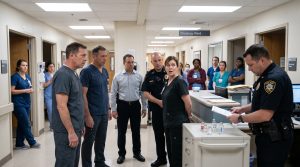
I agreed to wear a hidden audio transmitter and accompany the investigators back into St. Jude’s. Uniformed police officers and federal agents entered the fourth-floor oncology wing just as Helen took her post at the central nursing station. The hallway was filled with the usual evening bustle—shift nurses trading patient handoffs, medication carts rattling along the floor, and visiting relatives walking quietly past open doorways.
The lead investigator, flanked by county deputies, stepped past the counter.
“Helen Davis?” the officer announced, his voice slicing through the quiet chatter.
Helen’s head snapped up from the computer display. “Excuse me, you can’t be back here without clearance,” she said, her voice sharp with conditioned authority.
“Helen Davis, you are under arrest for conspiracy to distribute controlled substances, tampering with consumer products resulting in serious bodily injury, and healthcare fraud,” the investigator declared calmly.
The room plunged into utter silence. Nurses froze with IV tubing in their hands. Visitors stopped in the hallway. Helen’s face drained of color as the deputy brought her hands behind her back and fastened steel handcuffs around her wrists. Her gaze darted across the floor, landing squarely on me standing near the service doors. In that split second of realization, her imposing mask shattered completely.
A few doors down, federal agents were already executing a search warrant in Dr. Ross’s administrative suite, impounding electronic devices and private practice financial ledgers.
The fallout was grueling. St. Jude’s administration suspended me with pay during the legal proceedings, and several long-time colleagues accused me of staining the hospital’s name. But three weeks later, while walking into a local diner, I was stopped by a woman whose grandfather had passed away on the oncology floor a month before the arrests. She didn’t shout or draw attention. She simply took my hand in hers, tears welling in her eyes, and said, “We thought he was losing his mind. We thought nothing could ease his pain. Thank you for telling the truth.”
Standing on that sidewalk under the gray autumn sky, the fear and uncertainty of the future lifted. In an era where institutional pressure often demands quiet complicity, the courage to speak remains the only true shield the vulnerable have. I had worked nineteen years in the basement darkness, but in the end, it was the light that set us free.