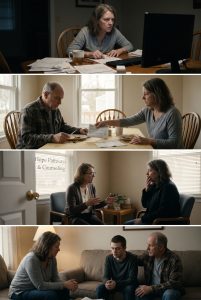
 There are few places colder than an Ohio kitchen at 5:00 AM, but the real frost that morning wasn’t outside. It was the white-hot dread pooling in my chest as I sat at the wooden table, the glow of my laptop illuminating decades of a life I thought I knew.
It started with a routine check. I had taken over the family finances again after my husband, Richard, started looking more tired, always mumbling about “work dinners.” When I pulled up the credit card statement, I was looking for a streaming service we forgot to cancel. Instead, I found a ghost.
A $142.00 charge. Every single Wednesday. Four years.
My heart did the math before my brain could stop it: $7,384 a year. Across four years, that was $29,568. The charge was always listed under the cryptic name H.P.C. Svcs.
I remember the exact moment the room went quiet, save for the rhythmic humming of the refrigerator. Richard had told me, repeatedly, that those Wednesday late afternoons were spent at the diner near the railyard, trying to placate some notoriously demanding logistics clients. But clients don’t eat exactly $142 of diner food every Wednesday at 4:30 PM for four years.
A sickness took hold of me—the awful, familiar fear of betrayal. We’d been married for thirty-one years. We’d survived layoffs, the recession, and the grueling, heart-shattering years of raising our son, Tyler, whose teenage and twenty-something struggles with addiction had almost torn us apart before he moved out to Columbus. I’d thought we were in the clear. I’d thought we were finally safe.
I didn’t scream. I didn’t cry. Instead, a cold, protective survival instinct kicked in. In the quiet of the morning, I logged into our joint high-yield savings account—money we had painstakingly built up for retirement and emergencies—and moved $210,000 to a brand-new, solo savings account at a completely different bank. If my life was about to be destroyed, I was going to make sure I had the ground to stand on.
Then, I printed out the bank transfer confirmation and the credit card statement, folding them with precise, deliberate care.
When Richard shuffled into the kitchen at 6:30 AM, smelling of shaving cream and coffee, he saw the breakfast I had made—and the white papers sitting exactly by his plate.
He didn’t need to read them to understand. He looked at the bank logo, then up at me, his eyes instantly clouding with a heavy, profound exhaustion. Slowly, he pulled out his chair and sat down. He didn’t touch his coffee. He set his fork down very carefully on the placemat, as if the slightest noise might shatter the room.
“You weren’t supposed to find that, Sarah,” he said, his voice barely above a whisper.
“What is it, Richard?” I asked, my voice trembling despite my best efforts to keep it steady. “Is it another woman? Are you paying someone? A gambling debt? Explain to me how nearly thirty thousand dollars disappears without me knowing.”
He rubbed his face with his hands, his shoulders slumping so far he looked ten years older. “It’s not what you think. I swear to God, Sarah, it’s not what you think. Just… let me talk to them. I’ll get it sorted.”
“No,” I said, sliding the paper closer to him. “You’re going to tell me now.”
“I can’t,” he whispered, looking genuinely broken. “I promised. I had to.”
The sheer refusal to tell me the truth was the final straw. I took my car keys and left. On the drive, I Googled the initials H.P.C. Svcs. It didn’t take long to find it: Hope Pathways & Counseling, a private, intensive outpatient therapy and rehabilitation center on the outskirts of Columbus.
My throat went dry. A counseling center? A rehab?
I called instead of driving over, my hands shaking so hard I had to pull over to the side of a gravel road. I demanded to speak to whoever was in charge, my voice tight with panic. A few minutes later, a warm, calm voice came on the line. She introducing herself as Dr. Angela Vance. After hearing my frantic, barely coherent questions, she paused.
“Mrs. Thompson,” Dr. Vance said gently, her tone completely devoid of the defensiveness I had expected. “If you can come in, I think it would be best. I can’t discuss anything over the phone, but… please, come.”
The drive to the clinic was a blur of highway and tears. When I arrived, Dr. Vance met me in a quiet, carpeted side room away from the busy waiting area. She brought me a cup of water and sat opposite me, her face filled with a heavy, compassionate look.
“He’s been coming here alone, Sarah,” Dr. Vance began, her voice soft but direct. “He didn’t want you to know. Not because he was hiding something bad, but because he was trying to protect you.”
I stared at her, confused. “Protect me from what?“
“Your son, Tyler,” she said.
I felt the air leave my lungs. “Tyler? But Tyler… he told us he was fine. He’s been living on his own, working, he said he was sober.”
“He was trying to be,” Dr. Vance explained. “Four years ago, Tyler had a massive relapse. He was on the verge of losing everything—his job, his apartment, his life. He reached out to his father, but he made Richard promise, on everything he held dear, that he wouldn’t tell you. Tyler was terrified that if you found out, you’d never forgive him, that it would kill you. You’ve been through so much, Sarah. Richard saw how the previous years had nearly broken you, and he made a choice.”
She looked down at her hands, then back at me. “Richard has been paying for Tyler’s weekly outpatient therapy, his group sessions, and his medical monitoring out of his own pocket, a little at a time, to keep it off the main insurance so you wouldn’t see it. The $142 a week was Tyler’s counseling and relapse-prevention therapy. Richard didn’t just pay for it; he came here every Wednesday evening to sit in family support sessions, to learn how to help him, and to carry that burden alone so you wouldn’t have to.”
The room seemed to spin. All those Wednesdays. All those times I had resented Richard for “working late” or being distant. He wasn’t avoiding me; he was sitting in a therapist’s office, holding our son’s life together with his bare hands while trying to keep the storm from reaching our front door.
“He wanted to protect you, Sarah,” Dr. Vance continued. “He promised Tyler he would shield you until the treatment worked, until the boy was strong enough to stand on his own. In our last session, Tyler said he is finally ready. He’s been sober for eighteen months now. Really sober. He’s ready to tell you the whole truth about when he was… about everything.”
I sat in that quiet office, the water untouched in my hands, as the walls of my suspicion crumbled into a vast, overwhelming wave of grief and gratitude.
When I finally got back home, the house was quiet. Richard was sitting in the living room, staring at the blank television screen. He looked up when the screen door clicked, his face guarded, waiting for the blow.
I didn’t say a word. I walked over to the couch, sat down beside him, and reached for his hand. It was rough, worn, and trembling.
“I talked to Dr. Vance,” I whispered, my voice thick with tears.
Richard’s eyes closed, and for the first time in four years, I saw him truly let go. He leaned his head forward, and the heavy, silent tears of a father who had carried a mountain alone finally broke.
“I’m sorry, Sarah,” he sobbed, his voice cracking. “I’m so sorry I lied. I just couldn’t let him go. And I couldn’t let you break again.”
“Oh, Richard,” I said, pulling him close, my own tears falling into his hair. “You didn’t have to do it alone. You never had to do it alone.”
We sat like that for a long time, the shadow of our past finally giving way to the messy, painful, but hopeful truth. Tyler came over that evening. He didn’t look like the ghost of the boy we had lost years ago; he looked tired, but his eyes were clear, and his hands were steady. He sat on our couch, looked me in the eye, and told me everything.
It was a long, hard conversation, filled with tears and apologies, but as I looked at my husband and my son, I realized the $210,000 I had moved didn’t matter. The only account that needed settling was the one we had finally opened to each other.
The path ahead of us wasn’t perfect, but for the first time in four years, we were walking it together, no longer hiding in the dark.
And on the following Wednesday, at 4:30 PM, we all went together. Here are the images from our journey.