 The receipts were small, crumpled things, and they lived in the bottom of a ceramic bowl on our kitchen counter. For six years, they accumulated like silent, paper dust. Most were for exact amounts—$35, $42, $58—always from a Sunoco on Route 41, and always dated on a Tuesday afternoon.
Over seventy-two months, those Tuesdays became the quiet, unseen rhythm of our marriage. My husband, Arthur, would leave our house in the suburban outskirts of Terre Haute, Indiana, at exactly 2:00 PM. “Just running some errands, Clara,” he’d say, grab his keys, and disappear into his beat-up Ford F-150. He’d return before dinner, grease on his knuckles, his expression distant but peaceful.
When I finally tallied the bank statements and the crumpled paper trails, the sum was staggering: over $3,700 spent at a single gas station on Route 41, a stretch of highway that led to nowhere we ever visited together. In the darker corners of my mind, the math of his absence felt like a betrayal. I imagined the worst. A secret life. A gambling debt. Another woman. I didn’t want to ask, terrified of the answer.
But last month, the weight became too heavy. Driven by a desperate need for the truth, I took the day off work, got into my car, and drove down the long, flat stretch of Route 41.
The Sunoco was exactly as I had pictured: a weathered, gravel-strewn station with faded signs and rusted garage bays, a relic of an older America clinging to the roadside. Inside, the air smelled of stale coffee and motor oil. I approached the counter, my heart hammering against my ribs, and showed the woman behind the register a photo of Arthur on my phone.
“Do you know him?” I asked, my voice barely a whisper. “He comes here every Tuesday.”
The woman, whose name tag read Evelyn, looked at the screen. A slow, warm smile broke across her face.
“That’s Arthur,” she said, her voice rich with a gentle familiarity. “The man who teaches the fatherless boys how to change oil. He pays for all the parts himself.”
My chest tightened, but not with the anger I had prepared for. It was a sudden, breathless confusion.
Evelyn reached into a drawer beneath the counter and pulled out a worn, slightly bent photograph, handing it to me. “I took this last summer,” she said.
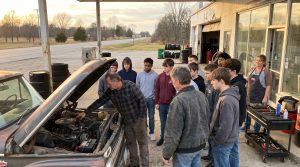
In the photograph, Arthur was bent over the open hood of a rusted pickup truck, pointing out something in the engine bay to a group of about ten teenage boys. They were huddled close, their eyes fixed on his hands. They wore worn hoodies and jeans, and one of them—a tall, lanky teenager with a quiet expression—was wearing Arthur’s old, heavy canvas work jacket. The very one I thought he’d lost years ago.
“He started it six years back,” Evelyn continued, leaning against the counter. “There’s a lot of kids around here who don’t have anyone to show them how to do the basic stuff—how to turn a wrench, change a tire, or check their brakes. Arthur just showed up one day, bought a bunch of tools, and told me he wanted to help. He said if any of the local boys needed to learn, he’d be here every Tuesday. He buys the filters, the oil, the spark plugs, and the old beaters for them to practice on. That’s what those receipts are for, honey. He never took a dime from anyone.”
She paused, her eyes softening as she saw the tears gathering in mine.
“He told me it was the only way to honor the son he lost before he met you. Jimmy, right? He said Jimmy would have been about their age when he passed. The last time Arthur was here, he told me if you ever came looking, I should tell you…” She smiled, her voice dropping to a tender whisper. “He should say he is just keeping his promise to a boy who never got to grow up.”
I looked down at the photograph. The image of my husband, a man who had carries his grief so quietly for so many years, surrounded by a group of young men who needed him as much as he needed them, blurred through my tears. The $3,700 wasn’t a betrayal; it was the price of grace, paid in motor oil and time, on a quiet stretch of Route 41.
I thanked Evelyn, took the photograph, and drove home in a silence that felt entirely different from the one I had lived with. That Tuesday evening, when Arthur came home, his jacket gone and his hands stained with grease, I didn’t ask him about the receipts. Instead, I met him at the door, wrapped my arms around him, and held him tighter than I had in years, grateful for the quiet, beautiful heart of the man I loved.