Every Sunday at precisely two in the afternoon, the gravel would crunch beneath my tires as I pulled into the visitor’s lot at Cedar Crest Seniors Community. For four years, this was the soundtrack to my weekends. I’d grab my purse, adjust my face, and walk through the heavy glass doors that smelled eternally of lavender-scented disinfectant and industrial floor wax.
And every Sunday, without fail, my mother was waiting.
She was usually in the sunroom, her frail frame dwarfed by a floral armchair. The moment she saw me, her worn face would light up with a smile that could cut through any gloom. “Oh, Heehly, my girl,” she would say, her voice paper-thin but rich with warmth.
“How are you, Mom?” I would ask, kissing her soft, wrinkled cheek. “How’s the food? Are they taking good care of you?”
“Everything is fine, sweetheart. Just fine,” she would reply, her hands patting mine. “The girls here are so sweet. They played bingo on Thursday, and I had a lovely view of the garden.”
She never complained. Not once. She didn’t complain about the lukewarm tea, the slow response times to the call button, or the echoing loneliness of the hallway when night fell. She was the model resident, always pleasant, always insisting she had exactly what she needed.
Meanwhile, the reality of her care lived on my desk at home, in the form of a monthly invoice: $8,400.
In America, aging is a luxury that few can truly afford, and we were always on the precipice of falling over. Between my job as a mid-level administrator, my husband’s fluctuating freelance income, and our daughter’s college tuition, that $8,400 a month was a crushing, suffocating weight. We had refinanced the house, dipped into retirement, and slashed our budget to the bone. Every invoice felt like a ticking clock, a reminder of the relentless cost of keeping a loved one safe and cared for. I was drowning, but I did it willingly, telling myself that as long as Mom was happy and safe, every penny was worth it. She was worth it.
Two weeks ago, on a rainy Tuesday morning, the call came. Her heart, tired and worn, had simply stopped in her sleep.
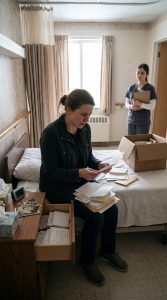
The grief was a heavy, numbing fog, but the administrative gears of life do not stop for tears. Yesterday, I had to return to Cedar Crest to pack up the remnants of her four-year existence. I stood in her vacated, Spartan room, staring at the empty bed, the bare walls where her framed photos of our family used to hang, now packed away in a cardboard box on the floor. The transition from a lived-in space to an institutional void was jarring, leaving a hollow ache in my chest.
A gentle knock at the door broke the silence. It was Elena, one of the daytime aides who had cared for Mom since she arrived. Elena’s eyes were soft, her scrubs worn but neat, holding a Clipboard and a small, vintage wooden drawer she had pulled from the bedside nightstand.
“Heehly,” Elena said quietly. “I’m so sorry for your loss. Your mother was a beautiful soul. I wanted to make sure you got this. I found it in the back of her drawer when I was clearing out the nightstand. She kept them tucked away, beneath the old crossword puzzle books.”
She handed me the small drawer. Inside, resting in a neat, rubber-banded stack, were dozens of greeting cards. Envelopes of various faded colors, entirely unaddressed, but each with a date carefully handwritten in my mother’s script on the top right corner.
There were 48 of them. Exactly one for every month she had lived at Cedar Crest.
My hands began to shake as I sat on the edge of the unmade, empty mattress. I slipped the rubber band off. The topmost envelope, dated only a week before she passed, felt heavy in my fingers. I pulled out the card—a cheap floral drugstore find—and opened it.
The handwriting was unmistakably hers, shaky but determined.
“October 2026. My dearest Heehly,” it began. “Today was Sunday, and I saw your car pull in at 1:55 PM, just like you always do. I watched from the window. You looked so tired, my sweet girl. You carry so much on those shoulders. I hate that I am one of those burdens. The girls tell me you pay so much to keep me here, $8,400 a month. I cannot bear the thought of what that is doing to your life, to your family. I smile every Sunday because I never want you to carry the guilt of my unhappiness on top of that crushing bill. I paid extra ‘fees’ of my own, the fee of silence, so you wouldn’t worry. Worry is a terrible thief, Heehly. I never wanted you to worry about me.”
A tear fell, starched and dark against the paper. I turned the card over, my heart breaking in my chest.
“Tell my daughter the quiet nights were hardest,” the handwriting continued, growing fainter. “I never wanted to be a burden, but I waited every Sunday for her car. If she reads this, please tell her I love her, and that she gave me the greatest gift a daughter could—a place where I could rest, even when the rest was lonely. You did enough, Heehly. More than enough. Please, let go of the worry now.”
The final card in the stack, dated the day before she died, was barely a few lines. It was a final benediction, written as her strength was failing, a frantic attempt to leave behind a peace she had spent four years pretending to have.
“I am so tired tonight, Heehly. But I am not afraid. I have my cards, my memories, and I have the memory of your car in the gravel. If you read this, please tell her I went to sleep thinking of her. Don’t look back with sadness, my darling. You gave me my peace, even if it cost us both so much.”
I pressed the cards to my chest, the paper crinkling under my grip.
For four years, we had engaged in a silent, heartbreaking dance. I had nearly destroyed myself financially to afford her care, believing it was the only way to prove my love. And she, realizing the toll it was taking, had worn a mask of perfect, untroubled contentment to protect me from the emotional cost, enduring the loneliness and the “quiet nights” without a single murmur of complaint.
In the end, the price of her care hadn’t just been the $8,400 a month on the invoices. It was the unyielding, invisible cost of a mother and daughter trying to spare each other from the unbearable weight of aging in a world where peace has a price tag.
I looked up at Elena, who was standing respectfully near the doorway, watching me with a look of quiet, understanding empathy.
“Thank you, Elena,” I whispered, my voice thick with tears.
I packed the boxes, including the precious drawer of 48 unsent cards, and walked out of Cedar Crest for the very last time. The gravel didn’t crunch beneath my tires the same way as I drove out of the parking lot. The crushing weight of the monthly invoices was gone, replaced by a deep, aching void, but beneath the grief, there was also a quiet, enduring gratitude.
Mom had wanted me to let go of the worry. As I drove home, her cards resting on the passenger seat, I made a promise to do just that—to carry her love forward, stripped of the debt and the guilt, remembering only the grace of her Sunday smiles and the quiet nights she had survived, just for me.