The report card had sat between two sweating glasses of iced tea on a sticky laminate table in the autumn of 2013. An eighty-three percent in pre-calculus. In any normal household, an eighty-three was a pass, an acceptable detour on the way to a high school diploma. But in a Pennsylvania mill town where the foundry had shuttered six months prior, where every father on the block was watching his pension evaporate into corporate bankruptcy filings, that single letter “B” felt to Robert like a structural failure.
Robert had worked thirty-two years at the stamping plant, his hands permanently lined with grease that soap could never quite touch. He believed in precisely two things: that the world was waiting with open jaws to swallow lazy men, and that fear was the only reliable fuel for survival. When Jake looked up from the table, sullen and tired from four hours of varsity football practice, Robert did not see a exhausted sixteen-year-old boy. He saw a mirror of his own precarious existence.
“You think this buys a future?” Robert had shouted, his voice cracking against the quiet hum of the refrigerator. “Out there, people eat kids like you for breakfast. You shape up, Jake. You give everything you have, or you pack your things and move out of my house.”
Robert had expected tears. He had expected the familiar slam of a bedroom door, perhaps a week of stony silence before routine smoothed over the edges of their disagreement. What he had not anticipated was the absolute stillness in Jake’s eyes. Jake had simply stood up, walked down the narrow hall, and returned ten minutes later wearing his winter coat, carrying a battered canvas backpack, and clutching the twenty-dollar bill he had earned mowing lawns the weekend before.
The screen door clicked shut. The gravel driveway crunched under sneakers. Robert stayed in his chair until the tea melted the ice down to tepid water, stubbornly telling himself that the boy would turn back before he reached the county line.
He didn’t.
Thirteen years carved their way through Robert’s house like water through soft limestone. The plant closed for good. Robert retired with a modest union stipend, a bad hip, and an echoing silence in a three-bedroom ranch that suddenly had far too many corners. Every Thanksgiving and Christmas, without fail, he set a fourth place at the table—fork on the left, knife and spoon on the right, an empty blue ceramic plate that gathered dust while he ate his turkey in front of a flickering television. The plate was an altar to his own stubborn stupidity, a silent daily confession that his fatherhood had collapsed under the weight of his own terror.
Then came a rainy Tuesday morning in aisle six of the Walmart Supercenter on Route 11.
Robert was reaching for a box of tea when Coach Miller turned the corner, his cart loaded with paper towels and motor oil. The coach had aged into gray whiskers, but his voice still carried the clipped cadence of the high school sidelines. He stopped mid-stride, staring at Robert with an unreadable expression.
“Robert,” Miller said, leaning over the handle of his shopping cart. “I figured you were down in Florida by now.”
“Still here, Coach,” Robert said, his throat instantly dry. “Still in the old place.”
Miller nodded slowly, looking past Robert’s shoulder before speaking with careful deliberate weight. “Jake bought out Henderson’s Hardware over in Greenburg last spring. He took down the old lumberyard wall, expanded into commercial contracting. Employs fourteen people now. Full benefits, too. He turned that whole corner of town around.”
The plastic bottle of dish soap slipped from Robert’s fingers, landing with a dull thud against the wire basket of his cart. He could not breathe. For thirteen years, his mind had constructed a thousand quiet tragedies—shelters in Philadelphia, forgotten dormitories, late-night phone calls from distant precincts that never came.
“He’s got a wife, Sarah,” Miller added quietly, stepping closer. “A schoolteacher from Altoona. And a boy. Named him Leo. Kid has Jake’s exact stubborn chin. Looks just like Jake did when we won the division back in twelve.”
Miller reached into his fleece vest, pulled out a glossy cardstock flyer, and laid it directly across the top of Robert’s groceries. “Grand reopening is in ten days. New storefront, new supply bay. Jake’s been asking about you. He doesn’t say much, but he asked.”
Robert spent the next ten days living in a suspended state of panic. The flyer sat on the kitchen counter beside the salt shaker: Kowalski Supply & Hardware: Rebuilding Our Community from the Ground Up. Every evening, Robert stared at the bold letters, his chest aching with a raw, physical humiliation. What right did he have to walk across that threshold? What did an old, broken-down machinist have to say to a man who had built an empire out of twenty dollars, spite, and raw labor?
On Saturday morning, Robert polished his work boots. He ironed his cleanest flannel shirt, the heavy wool one with pearl-snap buttons, and drove thirty-five miles south into Greenburg.
The parking lot was overflowing. Local fire department trucks sat on the perimeter with banners flapping in the October breeze. The smell of hot cider, fresh-cut pine, and grilled hot dogs hung thick in the cool autumn air. Families bustled past carrying rolls of insulation and boxes of nails, their laughter ringing against the corrugated metal siding of the warehouse.
Robert stepped through the wide glass doors, his knuckles white around the keys in his pocket. The store was bright, immaculate, and humming with purpose. Rows of polished steel tools, towers of timber, and neat displays of American-made hardware stretched into high ceilings. Behind the central counter stood a tall, broad-shouldered man with rolled-up sleeves, laughing easily as he handed a receipt to an elderly contractor.
It was Jake.
The softness of the teenage boy was entirely gone. In its place was a man forged by thirteen years of hard asphalt and heavy lifting. There were faint silver threads near his temples and calluses thick as bark on his fingers.
As the contractor walked away, Jake lifted his head. His eyes swept across the crowded registers, and then, across thirty feet of open aisle, they locked onto Robert.
The air evaporated from the room. The chatter of customers and the beeping of scanners vanished into a dull roar. Neither man moved. Robert felt his knees tremble beneath him, the instinct to turn and bolt out the exit clawing at his throat. He saw thirteen years of absence, thirteen years of missing birthdays, missed graduations, missed weddings, and the heavy, unforgiving weight of the words “move out.”
Then Jake reached down, tapped his assistant on the shoulder, and pointed toward the rear stockroom. “Take the counter for five minutes, Dave,” he said. His voice was deeper than Robert remembered, but the cadence was unmistakably his own.
Jake stepped around the counter and walked directly toward his father. He didn’t smile, but his jaw wasn’t set in anger either; he simply walked with steady, measured purpose until he was standing two feet away.
“Dad,” Jake said.
Robert tried to speak, but his voice caught in his chest like dry kindling. He looked at the floor, then at the bright fluorescent lights, and finally forced himself to meet his son’s eyes. The pride that had choked his life for decades finally gave out.
“I was wrong, Jake,” Robert whispered, his voice cracking in the open store. “I was so damn terrified of you failing that I drove you out into the dark. There hasn’t been a single night in thirteen years where I didn’t regret opening my mouth at that table.”
A small muscle jumped in Jake’s cheek. He looked past Robert toward the front entrance, where a yellow school bus rattled past on the highway outside.
“That night nearly killed me, Dad,” Jake said quietly, his words steady and stripped of cruelty. “I slept in a bus depot for three days before I found an apprentice gig framing houses. I hated you for five years. I worked eighty hours a week just to make sure you’d never hear that I fell on my face.”
Jake paused, drawing in a long breath that smelled of sawdust and engine grease. “And then Leo was born. And the first time he looked at me, I realized how terrifying it is to love someone that much. You think you’re going to break them. You think every mistake you make is going to ruin their life.”
Jake reached out and placed a heavy, calloused hand on Robert’s shoulder. The grip was firm, warm, and entirely forgiving.
“You gave me a twenty-dollar bill and a terrible lesson, Dad,” Jake said, a faint, wry smile touching the corners of his mouth. “But you also taught me how to work until the job was done. Come here. There’s someone you need to meet.”
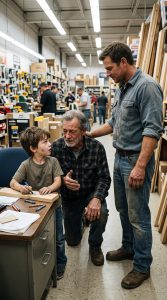
Jake turned and led him toward the small office behind the register. Sitting on a swivel chair, coloring with a broken blue crayon on a scrap of two-by-four, was a seven-year-old boy with messy brown hair and a small smudge of charcoal across his cheek.
“Leo,” Jake said softly. “Put the crayon down for a second.”
The boy scrambled off the chair, looking up with wide, curious hazel eyes—the exact same eyes that had once looked across an old kitchen table over a high school report card.
“This is your grandfather,” Jake said.
Robert knelt down on the hard linoleum floor, completely unbothered by the ache in his stiff knees, and extended a trembling hand to the boy. For the first time in thirteen years, the empty plate at the kitchen table had finally found its purpose.