The smell of antiseptic and old paper had never felt so suffocating. In the tiny, windowless consultation room of Mercer County Memorial Hospital, my father, Arthur, sat with his heavily calloused hands clasped tightly between his knees, his eyes fixed on the scuffed linoleum floor. Next to him, I sat on a vinyl chair, my heart hammering against my ribs.
On the other side of the cluttered desk, Dr. Joseph adjusted his wire-rimmed glasses and let out a long, heavy sigh. In his hands, he held the medical charts from my brother Frank’s emergency admission. Three weeks ago, Frank had fallen fifteen feet from an orchard ladder, his body breaking against the hard earth, requiring immediate surgery and a massive, life-saving blood transfusion.
Dad had already paid the $5,800 hospital deposit without a second thought, emptying his modest savings to ensure his eldest son got the care he needed. After all, Frank had worked Dad’s cattle pastures for 44 years. He was the eldest, the quiet anchor of our family, and—we always thought—the spitting image of our late grandfather, with his towering build and stubborn grit.
But then Dr. Joseph had called us into this room, away from the bustling hospital corridors.
“Arthur, Sarah,” Dr. Joseph began, his voice barely above a murmur. “When we prepare for a major transfusion, we run extensive cross-matching to ensure patient safety. Frank’s lab results came back with AB-negative blood.”
Dad frowned, his brow furrowing beneath the brim of his worn cap. “Yeah? And? He needed the blood, didn’t he? I told the nurses I’m O-positive, and I’d give him every drop I have if it would help.”
“That’s the problem, Arthur,” Dr. Joseph said gently, placing a hand on the open file. “Genetic inheritance is absolute. A parent with O-positive blood and a mother with O-positive blood—which your late wife, Martha, was—cannot biologically produce a child with AB-negative blood. It is scientifically impossible.”
I felt the air leave my lungs. “What are you saying, Doctor? Are you saying my mother had an affair?” The question felt like glass in my throat, defending the memory of the woman who had raised us with nothing but devotion.
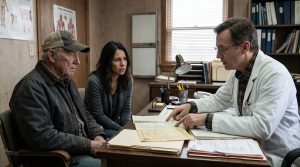 “No, Sarah,” Dr. Joseph said, reaching for a larger, older folder. “Before we sat down, I wanted to be absolutely sure. Because Mercer County Memorial is a small hospital with records dating back decades, and because this seemed like an impossibly rare anomaly, I requested the historical delivery logs from our archive. I wanted to see who else was in the maternity ward on June 14, 1982.”
He unsealed a faded, yellowing document—the county birth registry from that exact summer week forty-four years ago.
“Forty-four years ago, only two boys were born in this hospital within a three-hour window,” the doctor said, sliding a photocopy toward us. My eyes scanned the blurry typing. Mother: Martha Vance. Time of birth: 2:14 AM. And just below it: Mother: Evelyn Miller. Time of birth: 3:45 AM.
“June 1982 was the year of the big floods,” Dr. Joseph said quietly, his voice carrying the weight of history. “The hospital was running on generators, the staff was overwhelmed, and the nursery was chaotic. According to these records, the infant identification bands were hand-written, and… well, it appears there was a tragic, catastrophic mix-up before the babies were discharged.”
Bile surged into the back of my throat as my gaze locked onto the name. “The newborn switched with Frank…” I whispered, the words barely finding their way out. “It was… the Miller boy?”
“Marcus Miller,” the doctor confirmed, his finger pointing to the other name on the registry.
A cold, heavy silence fell over the room. Marcus Miller.
Everyone in our small county knew the Millers. They owned the rival grain elevator and a massive sprawling farm just twelve miles north. But more than that, Marcus was a man we had seen around town for decades. He was a quiet, hard-working mechanic with Dad’s exact sloping shoulders, his gentle demeanor, and—now that my mind was desperately putting together the puzzle—the exact, piercing hazel eyes that my father and I shared. A man we had passed in the grocery store aisle, exchanged nods with at the county fair, completely unaware that he was the biological son Arthur had never known.
And Frank? The big-hearted, stoic brother who had spent his life sweating over our herd, who had held Dad’s hand when Mom passed, who had given every ounce of his youth to our stubborn, rocky soil—he belonged, biologically, to a family of strangers.
Dad didn’t move. He sat like a man made of stone, his gaze locked on the papers. For a long, terrifying minute, the only sound was the hum of the hospital’s fluorescent lights.
“Arthur?” I reached out, my hand trembling as I touched his arm. “Dad?”
Slowly, Dad raised his head. He looked at the doctor, then at me. His eyes were watering, but his jaw was set with the same fierce, immovable resolve that had kept our farm alive through decades of drought and hardship.
“Does Frank know?” Dad’s voice was raspy, but it didn’t shake.
“Not yet,” Dr. Joseph said. “We wanted to speak with you first.”
Dad stood up, his joints protesting, and he adjusted his cap. “Then we aren’t going to tell him. Not now. Not while he’s lying in that bed trying to heal.”
“Arthur, there are medical histories to consider, and the Millers—”
“I don’t care about the Millers right now,” Dad interrupted, his voice dropping to a hard, protective whisper. “I’ve spent forty-four years watching that boy work himself to the bone for our name. I’ve seen him bleed on our fence lines, and I’ve seen him cry when we lost our first herd to the freeze. You can tell me whatever your paper says, Doctor, but that boy in there is my son. He is my blood, because I gave him my life, and he gave me his. That don’t change because of a nurse’s mistake in the dark.”
I choked back a sob, my heart swelling with a painful, beautiful pride.
“We need to find Marcus, though,” I said softly, looking up at my father. “Dad… he’s out there. He’s your son, too.”
Dad looked back down at the birth registry, his hand hovering over the name Marcus. His expression softened, a complex, agonizing mix of grief, wonder, and newfound responsibility washing over his weathered features. “Yeah,” he whispered. “We do. But we do it right. We do it careful.”
We left the consultation room and walked back to the intensive care unit.
Through the glass window of Room 108, we could see Frank. He was awake, pale but alive, with a maze of tubes and a heart monitor gently beeping beside him. His large, rough hands, so like the hands that had built our barns and comforted our livestock, rested on the white hospital blanket.
Dad walked in first, his heavy boots squeaking on the floor. He didn’t say a word about blood types, or registries, or the decades of a life that might have been. He just walked to the side of the bed, reached out, and took Frank’s hand in both of his, squeezing it with all the strength he had left.
“You doing alright, son?” Dad asked, his voice thick with emotion.
Frank offered a weak, tired smile. “I’m okay, Dad. Just ready to get back to the cattle.”
“You take your time,” Dad said, his eyes glistening as he looked down at him. “The herd can wait. We ain’t going anywhere.”
I stood in the doorway, watching them, knowing our world would never be the same. The truth would eventually have to be told, and the journey ahead—navigating two families, two histories, and the complicated landscape of identity—would be a long and difficult one. But as I watched my father hold his son, I knew one thing was certain: in the fertile, unforgiving soil of Mercer County, family wasn’t just born. It was grown, tended, and harvested with a love that no mistake could ever uproot. Let the papers say what they wanted; we were together, and we would face the truth as we had faced everything else—side by side, as family.