The dust in the old barn always seemed to catch the late afternoon sun just right, turning the air into a haze of floating gold. But on that Tuesday, the warmth of the Kansas autumn felt entirely absent. Sarah stood on the worn dirt floor, the chill of the breeze through the weathered oak slats pressing against her back.
In her hands, she clutched a stack of papers she’d retrieved from First State Bank only hours before—papers that had turned her world upside down.
Across from her stood her older brother, Darrell, leaning casually against a towering stack of hay bales. He wore his usual frayed canvas jacket and a grease-stained cap, his expression entirely unbothered as he shifted a chew of tobacco in his cheek. To him, this was just another day on the acreage. To Sarah, it was the day the foundation of their family crumbled.
“I asked you a question, Darrell,” Sarah said, her voice trembling but carrying a hard edge. “Twelve years. Twelve years you’ve had the keys to Dad’s accounts because you lived just two miles down the county road. You told me the farm was doing fine. You told me the medical bills were handled. So why is there only $420 left in the primary farm account?”
Darrell didn’t look at her. He spat a dark stream of tobacco juice onto the dirt, then slowly reached into his pocket. “Farming’s expensive, Sarah. You’d know that if you didn’t spend all your time in the city.”
“I’ve been back every other weekend since Dad got bad, Darrell! Don’t you dare play that card,” she shot back, stepping closer. “The bank records show a cash withdrawal of $135,000 last year. And funny enough, there’s a brand-new John Deere combine sitting in your shed right now. How do you explain that?”
Darrell’s eyes darkened. The casual posture vanished, replaced by a defensive, bulldog slouch. “Dad wanted me to have the equipment. He knew I was the one doing the work.”
“And what about the land?” Sarah’s heart hammered against her ribs, a suffocating weight settling in her chest. “The banker said the deed was transferred. Where is the deed, Darrell?”
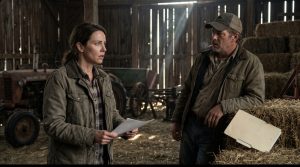 Without a word, Darrell reached onto a nearby hay bale, picked up a worn, legal-sized manila folder, and tossed it carelessly onto the straw between them. “Dad wanted me to have the land,” he said, his voice flat, devoid of the warmth they had shared as children. “He knew you wouldn’t keep it going.”
Sarah’s fingers shook as she reached for the folder. She pulled out the deed, the official-looking paper feeling heavy and cold. Her eyes scanned the document, skimming past the legal jargon until they landed on the bottom of the second page.
There, on the line for the grantor’s signature, was a shaky, uneven mark. It was meant to be their father’s name—Arthur C. Barreer—but Sarah knew their father’s handwriting like her own. By the time the deed was dated, their father’s Parkinson’s had progressed to the point where he could barely hold a spoon, let alone sign a legal document with that kind of deliberate, forced stroke. It wasn’t his natural, tremulous hand. It was a forgery, a crude attempt to mimic a dying man’s consent.
“This isn’t Dad’s signature,” Sarah whispered, her chest tightening until she felt as though a rib might crack under the pressure. “You forged this, Darrell. You made him sign away the family legacy while he was too sick to know what was happening.”
Darrell didn’t deny it. He just stared at her, his eyes cold and defiant. “He would’ve wanted me to have it,” he muttered, turning his back to her to inspect a piece of equipment. “I’m the one who stayed.”
“He trusted you!” Sarah cried, the betrayal cutting deeper than any financial loss ever could. “We both did!”
The weeks that followed were a blur of hushed phone calls, legal consultations, and the heartbreaking reality of hospice. Sarah spent every spare hour at their father’s bedside in the county hospital, holding his fragile, paper-thin hand as his breathing grew shallower. Arthur Barreer was 83, his mind fading into the twilight of Parkinson’s, unaware of the war being waged over the dirt he had spent his life tilling.
Sarah’s lawyer, an old family friend named Robert Vance, confirmed her worst fears. “It’s a tough road, Sarah,” Robert had told her over a cluttered desk in town. “Forgery is hard to prove when the person is incapacitated, and lawsuits destroy families. But if you have proof of the bank fraud, we can challenge the transfer.”
“I don’t care about the money, Robert,” Sarah had said, her voice cracking. “I care about what’s right. Darrell is stealing Dad’s peace, and he’s stealing our family’s history.”
Darrell refused to visit the hospice. When their father passed away quietly on a rainy Thursday morning, Darrell showed up at the funeral in a dark suit, sitting on the opposite side of the small chapel, refusing to meet Sarah’s gaze. The silence between them was louder than the hymns.
Following the funeral, the battle moved to the county courthouse. Sarah refused to back down. Armed with bank statements, handwriting analysis from a forensic expert, and medical records proving their father’s cognitive and physical inability to execute a deed at the time of the transfer, she pushed forward.
It was a grueling, painful process that laid bare years of resentment. Darrell’s defense crumbled under the weight of the financial trail. The $135,000 “purchase” was proven to be unauthorized, and the handwriting expert’s testimony was damning.
In the end, before a judge could issue a final, public ruling that would likely send Darrell to face criminal charges, Darrell’s attorney capitulated. They offered a settlement: the land would be returned to the estate, to be divided equally as their father’s original will had intended, and Darrell would forfeit his share of the remaining assets to cover the missing farm funds and legal fees.
A year after her father’s passing, Sarah returned to the farm one last time. The lawsuit was over, the land sold to a neighboring family who respected the soil, and the proceeds settled.
She stood on the porch of the old farmhouse, watching the wind rustle through the oak trees. The barn sat quiet, no longer a place of confrontation, but a monument to a lifetime of hard work.
She had lost her brother—the Darrell she grew up with was gone, replaced by a stranger consumed by greed—but she had saved her father’s legacy from being built on a lie. As she got into her car to head back to her own life, Sarah looked back at the fields. The harvest was over, the earth resting, and for the first time in a very long time, she felt a quiet, hard-won peace. She had sown the truth, and though the ground was scarred, it was finally, truly free.