The indoor pool at the Elm Street YMCA in Dayton, Ohio, always smelled of heavy chlorine, damp concrete, and the faint, comforting scent of worn-out communal life. For eight years, that smell had been my anchor.
When my husband, Frank, passed away in the autumn of 2016, the quiet in our small suburban house had felt like a physical weight, pressing down on my chest until I could barely draw a breath. We had been married for forty-one years, living a life of quiet routines, Friday night fish fries, and shared history. After he was gone, my neighbor, Barbara, practically dragged me to the Tuesday morning water aerobics and swim classes. “You need to keep moving, Martha,” she had insisted. “The water carries you when your own two feet can’t.”
She was right. In the water, my arthritic knees didn’t ache, and for forty-five minutes, the constant, gentle splashing drowned out the silence of my empty home.
The oddest thing about those eight years was the YMCA membership. Frank had always handled our finances, and in the blur of my grief, I hadn’t known where to look or what to do. But every month, my member scan card worked. When I finally gathered the courage to visit the front desk to update my billing, the young man behind the counter stared at his screen, tapped a few keys, and smiled. “You’re all set, Mrs. Higgins. There’s a pre-paid lifetime family and community endowment link on this account. It’s been taken care of.”
I assumed Frank, ever the forward-thinker, had quietly paid it off before his diagnosis took him. He was a retired Machinist’s Union representative—a man who believed in community spaces, hard work, and the security of a paid-up tab. I felt a quiet wave of gratitude every Tuesday, imagining him looking out for me, making sure I had a place to go.
But last Tuesday, the routine broke.
The 9:00 AM “Silver Splashers” class had just wrapped up. The pool was still, the water’s surface reflecting the gray, overcast Ohio sky through the high, wired-glass windows. I was wrapping a faded blue towel around my shoulders, preparing for the chilly walk to the locker room, when Sarah, our instructor, walked over.
Sarah was in her late thirties, with a quick, easy laugh and a tireless patience for our group’s endless chatting. She had been leading the classes for just over a year, having moved to Dayton from out of state.
“Martha, do you have a few minutes before you head out?” she asked, her voice unusually quiet. She wasn’t in her usual cheerful rush to pack up the pool noodles.
“Of course, Sarah. Is everything okay?”
She reached into her canvas bag on the guard’s chair and pulled out a worn, slightly faded manila folder. “I was told to give you this today. It’s… well, it’s about your husband. And your membership.”
I took the folder, the cardboard rough against my damp fingers. Inside was a stack of financial ledger prints from the YMCA’s administrative office, but clipped to the top was a piece of lined paper, yellowed at the edges.
I recognized the handwriting instantly. It was Frank’s heavy, left-handed slant, written with the blue ballpoint pens he used to keep in his breast pocket.
The letter was dated August 14, 2016—barely a month before he passed. My hand began to tremble as I read:
Martha, my love,
If you are reading this, it means I’ve been gone for a while, and it means the folks at the Y finally did what I asked them to do once the time was right.
I know how hard it’s going to be when I’m not there. I know you’re going to want to close yourself off in that big house. Please don’t. Go to the Y. Keep moving. I’ve made sure your fees are covered for as long as you need them, but there’s something else I needed to do before I went. Something I should have told you, but I wanted to be absolutely sure first.
You remember the boy we lost? Our Henry?
The words on the page blurred. My heart hammered against my ribs, the damp air of the pool suddenly suffocating. Henry.
In 1982, our six-year-old son, Henry, had gone to the municipal pool with his cousins while Frank and I were working. There was no lifeguard on duty. He had slipped into the deep end, and by the time anyone noticed, it was too late. The grief of losing Henry had nearly broken us. It was a phantom pain that lived in the corners of our house, unspoken but omnipresent. Frank had never forgiven himself for not being there, and for years, he had quietly donated whatever spare change we had to water safety programs, though he could never bring himself to step near a pool again.
I forced my eyes back to the page:
I couldn’t save Henry, Martha. That’s a shadow I’ve carried every single day. But about a year before I got sick, I started looking into where our little monthly donations to the county youth fund were actually going. I wanted to see if we were really helping.
I found him, Martha. Well, not him, but what he could have been. I found out where the scholarship we set up in Henry’s name—the “Henry Higgins Memorial Water Safety Fund”—went. Over the years, that small fund paid for swimming lessons for hundreds of kids who couldn’t afford them. One of those kids was a little girl from the East Side whose family was struggling. The Y covered her lessons, her lifeguard training, and eventually her certification.
She grew up, Martha. She went to college on a community scholarship, and she chose to spend her life teaching others how to stay safe in the water. She became a protector. A lifesaver.
I found her. She teaches here now.
The instructor is your…
The handwriting trailed off, the ink smudged, as if he had run out of strength or courage to finish.
“Martha?” Sarah’s voice broke the silence.
I looked up from the letter, my eyes swimming with tears, and then down at the photograph tucked behind the payment ledgers. It was a copy of an old newspaper clipping from the Dayton Daily News from 1998. It showed a young, teenage girl receiving a YMCA youth safety award, her arm around an older instructor.
I stared at the girl in the photograph. She had my eyes—the slightly downturned, hazel eyes I inherited from my mother—and she was laughing with a wide, un-self-conscious grin that was the spitting image of my late mother’s smile. It was Sarah.
“I didn’t know until a few months ago,” Sarah said, her voice catching as she stepped closer, her own eyes bright with unshed tears. “The director here told me when I took the job. Your husband… Frank… he didn’t just fund my first swimming lessons when I was seven. When my family was about to lose our apartment, he quietly went to the Y board and made sure my scholarship was extended to cover after-school care so my mom could work her second shift. He watched me grow up from a distance. He told the director he didn’t want to interfere, but he wanted to make sure ‘Henry’s sister in spirit’ was taken care of.”
She reached out, her hand gently resting on my forearm. “He set up a trust before he died, Martha. It didn’t just pay for your classes. It funded my position here, ensuring this program would always have a full-time instructor to teach the kids from the neighborhood. He wanted to make sure I was here for you, too, when the time came.”
The weight of eight years of grief, of forty years of carrying Henry’s absence, seemed to shift, transforming from a heavy anchor into something else—something that felt remarkably like a bridge.
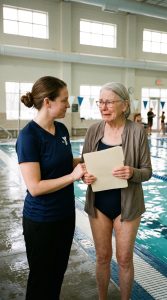 I looked at Sarah, really looked at her, seeing the living legacy of a man who had refused to let his greatest tragedy be the final word of his life. Frank hadn’t just left me a membership; he had woven a safety net, capturing a young girl’s future and, decades later, catching his grieving widow in the very same grasp.
“Frank always did like to have a plan,” I whispered, a wet, trembling laugh escaping my throat.
Sarah smiled, and in that moment, the resemblance to my mother’s gentle, spirited laugh was unmistakable. “He was a good man, Martha.”
“He was,” I said, closing the folder and reaching out to pull her into a tight, tearful embrace. “He really was.”
The water in the pool behind us was perfectly still now, but the ripples of what Frank had started so many years ago were still moving, carrying us both forward into the quiet Ohio afternoon.