The automatic glass doors of Shady Pines Haven parted with a faint pneumatic sigh that had, over twenty-six months, become the rhythmic soundtrack to my Sunday afternoons. The lobby always smelled faintly of industrial lavender floor polish and damp oatmeal, an olfactory mask designed to reassure families that their loved ones were residing in comfort rather than confinement.
Every Sunday, I walked past the receptionist’s polished mahogany desk, took the elevator up to Room 214, and pushed open the heavy laminate door to find my mother sitting in her floral armchair. Her silver hair was neatly pinned back, her reading glasses hung from a beaded lanyard, and she always greeted me with an instant, luminous smile.
“Look at you, Lauren,” she would say, reaching out with cool, papery fingers to smooth the collar of my cardigan. “Working too hard again. You have circles under your eyes.”
“I’m fine, Mom. Just busy at the clinic,” I would lie, kissing her forehead.
“How is Maya’s math grade? Did she hear back from Michigan State yet?“
For forty-five minutes, she would steer the conversation firmly outward. She asked about my teenage daughter’s volleyball tournaments, my brother’s landscaping business in Denver, the price of gasoline, the weather forecast—anything to keep the focus off her own body. When I asked how she was feeling, her answers were brisk and dismissive: “Oh, just old bones complaining about the rain,” or “The nurses are very sweet, honey. Don’t you worry about me.”
And I let myself believe her, because believing her was the only way I could survive the monthly invoices.
In America, aging is not merely an emotional transition; it is an economic siege. When Mom’s vascular dementia and mobility began deteriorating after her stroke, my brother and I spent three frantic weeks touring suburban care facilities across Pennsylvania. Medicaid had an eighteen-month waitlist for acceptable beds, and Mom’s meager pension from thirty years as an elementary school administrative secretary disqualified her from immediate state aid but fell wildly short of private-pay rates.
The monthly bill arrived on the first of every month like clockwork: $8,400.
To meet it, I refinanced my modest three-bedroom split-level, liquidated my father’s leftover life insurance annuity, took on weekend telehealth triage shifts, and deferred every maintenance project on my house until the gutters sagged and the water heater rattled like a dying engine. Every dollar earned had a phantom claim on it before it even hit my checking account. I existed in a perpetual state of low-grade panic, caught squarely in the vice of the sandwich generation—trying to fund my daughter’s college tuition while keeping my mother in a clean, dignified room.
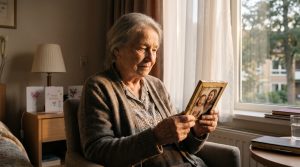 Whenever guilt threatened to suffocate me, the head nurse, a brisk woman named Brenda, would offer a practiced smile in the hallway: “Evelyn is doing wonderfully, dear. Eating all her meals, watching the afternoon game shows. She’s an angel.”
Two weeks ago, on a Tuesday morning at 5:15 a.m., my phone buzzed on the nightstand. It was not the frantic ring of an emergency, but the measured, apologetic tone of a night shift supervisor. Evelyn had passed away peacefully in her sleep. Heart failure, they said. Her breathing simply slowed, grew shallower, and stopped.
When I arrived at the facility to pack her belongings, Room 214 was already stripped of its bed linens. Her floral armchair stood empty in the corner, facing the muted television screen. On the edge of the unmade mattress sat Brenda, holding a small, fabric-covered blue notebook with a frayed elastic band.
“Your mother kept this in the bottom of her nightstand drawer,” Brenda said softly, handing it to me. “She wrote in it nearly every night. I think you ought to have it.”
I thanked her, placed the notebook in my canvas tote bag alongside Mom’s framed photograph of Maya’s eighth-grade graduation, and spent the next three hours mechanically folding cardigans, boxing slippers, and signing clearance forms.
It wasn’t until late that evening, after Maya had fallen asleep and the house went cold and silent, that I sat down at my kitchen table with a mug of black tea and opened the blue notebook.
The first page was dated twenty-six months ago, the week she moved into the facility.
April 14: The bed is stiffer than home. My hip caught when I tried to stand up for dinner. Took twenty minutes to shuffle to the bathroom. The aide was busy with Room 212. I did not ring the bell. Lauren looks so tired when she visits. She thinks I don’t see how thin she’s gotten.
My throat tightened. I turned the page.
July 22: Hip throbbing since dawn. Feels like ground glass in the socket. Dr. Miller stopped by and said the cartilage is gone. Needs replacement. I asked what the copay and physical therapy wing would cost. He said three thousand out of pocket plus an extra level of nursing care. I told him my daughter works seventy hours a week. I told him we will manage with Tylenol.
Page after page, the neat cursive that had once labeled my lunchboxes and checked my spelling homework detailed a quiet, agonizing ordeal. Forty pages of documented endurance. She wrote about nights spent clutching the bedrails while tears ran cold down her temples, waiting for dawn so the staff wouldn’t log an “acute pain incident” that might trigger specialized care fees. She recorded the exact moments she swallowed her moans into her pillow so her roommate wouldn’t call the floor desk.
And then, on an entry dated March 3rd of this year, written in trembling pencil:
Nurse Brenda wanted to dial the emergency transport this morning because my blood pressure spiked from the pain. I grabbed her wrist. I looked her in the eye and said: “Do not call my daughter. She has enough already.” Brenda promised she wouldn’t.
Tears fell hot against my knuckles, blurring the penciled graphite. I thought of all those Sunday afternoons—how I had sat in that armchair sipping weak tea, talking about lawnmowers and Maya’s SAT scores, completely blind to the torment masked behind her gentle smile. She had sat there, bearing agony in silence, purely to present me with the illusion of peace.
I turned to the final entry, dated barely eight weeks before she died. Attached to the leaf with a rusted paperclip was an unsigned surgical consent waiver from the regional hospital for an urgent femoral pinning and joint repair. Beneath it, Mom’s handwriting was frail, drifting downward across the unlined margin.
Dr. Miller says without the surgery, the immobility will strain my heart. He says if I refuse, I might have two months, maybe three. The procedure requires sixteen weeks of skilled rehabilitation at an upgraded tier. Fourteen thousand dollars out of pocket, Lauren. I saw the estimate.
I put the pen down. I refused the paperwork.
If you are reading this, my sweet girl, do not let your heart break with guilt. Tell her I chose this so she could keep her home. Tell her I chose this so Maya could go to college without a mountain of debt on her young shoulders. Tell her I chose this so she could finally take a deep breath on Sunday mornings.
You gave me twenty-six months of clean sheets, fresh flowers, and your beautiful company. You carried me as far as any daughter could ever carry a mother. Now it is my turn to carry you.
I sat in the dim kitchen as the refrigerator hummed its solitary note, clutching the notebook against my chest. In that quiet room, the brutal truth of our lives hung suspended in the air. In a society where growing old with dignity carries an impossible ransom, my mother had calculated the worth of her days against the future of her children, trading her breath for our survival.
I wept then—not only for the loss of her voice, but for the fierce, devastating magnitude of an American mother’s grace. And when the sun began to peek over the neighbor’s roof, casting a warm amber glow across the kitchen table, I closed the blue journal, stood up, and went upstairs to wake my daughter for school.