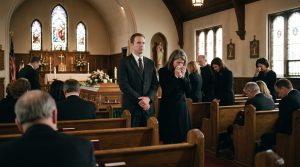
The sanctuary of St. Jude’s in Erie, Pennsylvania, was suffocatingly hot on that overcast Saturday in June of 2008.
The scent of white lilies was overwhelming, sweet and heavy like incense, mingling with the stifling humidity of an incoming Lake Erie thunderstorm. Nora sat in the front pew, her body shaking so violently that her knuckles turned stark white against the dark oak wood. In front of them rested the small white casket of their eight-year-old son, Julian, taken in less than forty-eight hours by bacterial meningitis.
Throughout the service, Nora had searched for her husband’s hand. But David stood beside her like an obelisk carved from granite. His dark suit was immaculate, his spine rigidly upright, his jaw locked in a rigid clench that did not shift when the choir sang, nor when the priest spoke Julian’s name.
Not a single tear fell from his eyes.
The entire congregation—friends from the plant where David worked as an assembly mechanic, neighbors from their cul-de-sac, extended family—watched him with a mixture of reverence and unease. To some, he seemed the very model of traditional American male fortitude, the unyielding rock upon which a broken family might lean. But to Nora, who was drowning in a sea of raw, jagged agony, his stillness felt like a personal abandonment. She looked at the man she had loved for twelve years and saw only an empty husk of emotional detachment.
When they returned to their quiet house that evening, David immediately changed into his work boots, walked into the backyard, and began weeding the vegetable garden until well past dark. He did not speak of Julian that night. He did not speak of him the following week, nor the month after that.
For Nora, the silence became toxic. She had another child to protect: their four-year-old son, Caleb, who kept wandering through the hallways asking when his big brother was coming back from soccer camp. David’s inability to mourn felt like a denial of Julian’s existence. Exactly six months after the funeral, Nora packed two suitcases, buckled Caleb into his car seat, and served David with divorce papers.
David had accepted the summons at the front door, signed the waiver of appearance without contesting custody or assets, and handed her the spare house key. He did not raise his voice. He did not beg her to stay. He simply looked at the porch floorboards and nodded once.
Seventeen years passed in the way that hard-working American lives tend to pass: measured in shifts, mortgages, and school calendar milestones.
Nora moved thirty miles south to Meadville, taking an administrative position at a dental group. She worked long hours to keep Caleb fed, housed, and clothed. As Caleb grew, he took after his father in build—tall, broad-shouldered, and quiet—but he possessed a boundless, kinetic passion for baseball. From Little League tee-ball through high school varsity, Caleb lived on the dirt diamonds of northwestern Pennsylvania.
David lived on the margins of their lives like a ghost. He sent his child support payment by cashier’s check on the first of every month without fail, but he never called, never visited, and never sought court-ordered visitation. Nora had convinced herself that David simply lacked the capacity for fatherhood—that when Julian died, whatever modest ember of parental affection David possessed had died with him. When Caleb asked about his father over the years, Nora kept her answers spare and sterile: “Your dad is a solitary man, Caleb. He chose his own road.”
Then, on a rainy Tuesday in mid-October, Nora’s phone rang.
The caller ID displayed a number from an Erie hospital. It was Evelyn, David’s younger sister, her voice ragged and hollow.
“Nora?” Evelyn choked out. “He’s gone. It was lung cancer. He only let them call me three days ago when the breathing got too bad. He didn’t want a service, Nora. But before they took him downstairs, he told me there was something in his apartment. A box in his bedroom closet. He made me swear I’d give it directly to you.”
 David’s apartment was a sparsely furnished one-bedroom unit above a dry-cleaning shop near the railroad tracks.
The room smelled of stale black coffee, cedar shavings, and old radiator heat. Sitting in the center of the threadbare dresser was a dented, olive-drab metal lockbox with a small brass latch.
Nora carried it to her car, her hands numb as she set it on the passenger seat. When she arrived home to her empty living room, she sat on the edge of the sofa, took a deep breath, and flipped the latch.
Inside, neatly stacked in chronological order, were fifty-one unopened greeting cards.
Every single one was addressed to Caleb.
There was a card for every birthday, every Christmas, and every Easter spanning seventeen years, beginning in December of 2008. Nora pulled out the first envelope. Tucked inside a simple Happy 5th Birthday card was a crisp, twenty-five-dollar check drawn from David’s credit union account, made out to Caleb, alongside a handwritten note: Happy Birthday, little buddy. Keep your eye on the ball.
She opened the next one. Christmas 2009. Another twenty-five-dollar check. Easter 2010. Another check. Fifty-one cards in total, totaling exactly $1,275 in uncashed twenty-five-dollar checks—the modest amount a retired factory hand on a fixed disability pension could set aside from his monthly groceries.
Nora’s chest felt tight, the blood pounding in her ears. She reached the bottom of the metal box.
Lying beneath the neat stacks was an unsealed white envelope, postmarked nowhere, with Nora’s name written across the front in David’s heavy, sloping pencil script. Inside was a card bearing an image of an autumn tree, dated three days before his death in the ICU.
Nora unfolded the sheet with trembling fingers.
Nora,
If you’re reading this, Evelyn kept her word. Give the checks to Caleb. I know it isn’t much, but I wanted him to know he was never forgotten on the days that mattered.
I never fought your divorce because you were right about one thing: you deserved a husband who could share your life, and I had become a dead man walking. But you were wrong about that morning at St. Jude’s. You thought I didn’t care because I didn’t weep.
Nora, I couldn’t cry that day because if I started, I would have never stopped. I felt like if I let the wall break, the sorrow would drown the whole church, and I wouldn’t have the strength to walk out and keep a roof over Caleb’s head. So I built a dam inside myself, and it turned me to stone.
I respected your space, but I never left my boy. I went to every single baseball game. Every Thursday twilight game at Lincoln Park, every Saturday tournament in Sharon, every sectional game when he played varsity for Meadville. I parked my truck past the gravel lot and stood behind the pine trees by the outfield fence with a thermos of coffee. He never knew it was me. I watched him hit his first home run over the left-field line when he was twelve. I watched him throw eighty pitches against Fairview in the championship. I stood in the rain and cheered until my throat was raw, but I never came through the gate because I promised myself I wouldn’t disrupt the peace you built for him.
Tell him his father saw every pitch. Tell him I was proud of every single inning.
David
A choked, ragged sound broke from Nora’s throat. She dropped the letter onto the coffee table, covered her face with both palms, and wept—hot, bitter, releasing tears that had been held captive in the frozen corners of her heart for seventeen years.
All those sunny June afternoons at the municipal ballfields came rushing back through her memory: the crack of the wooden bat, the parents shouting from the bleachers, and the distant, solitary figure in a faded ballcap and canvas jacket standing alone against the chain-link fence beyond the outfield trees. She had seen him a hundred times through the heat shimmer and assumed it was just an old neighborhood retiree enjoying an afternoon game.
It had been David. Holding his silent, loving vigil across the grass.
An hour later, the front door opened, and Caleb, now twenty-one and home on college break, walked into the kitchen carrying a gallon of milk.
He saw the open metal box on the dining table, the piles of cards, and his mother’s red, tear-streaked eyes.
“Mom?” Caleb asked, setting the groceries on the counter, his brow furrowed with concern. “What’s wrong? What happened?”
Nora stood up. She picked up the metal box, the fifty-one cards, and David’s final letter, carrying them across the room and placing them gently into her son’s strong, working-man hands.
“Your father passed away this morning, Caleb,” Nora said softly, her voice steadying as she looked into the face of the boy David had guarded from the shadows. “And there is a story about him you need to hear. Sit down with me. It’s time you met the man who stood by the outfield fence.”