The Wednesday Ledger
For nine years, Wednesday evenings in the Peterson household followed an unyielding, unspoken ritual.
Mark would arrive home from his job at the municipal water department at exactly 5:30 p.m., reeking faintly of outdoor grit and iron. He would kiss his wife, Sarah, on the temple, eat a hasty dinner of whatever was on hand, and then disappear into the bathroom. By 6:45 p.m., he would emerge wearing a freshly laundered, ironed button-down shirt. Without fail, he’d check his watch, grab his car keys, and say, “I’ll be back around nine, hon. Don’t wait up if you’re tired.”
When Sarah first asked about it, nearly a decade ago, Mark had simply shrug and said it was a “standing community commitment down at the lodge.” Sarah, herself exhausted by the grind of her shift work as an administrative assistant at the county clinic, didn’t press him. In a marriage that had survived the ultimate test of survival, privacy was sometimes a form of peace. They had learned, through years of unspoken trauma, that sometimes the only way to keep moving forward was to avoid looking directly at the cracks in the foundation.
But the silence became too heavy. The discovery happened on a wet Tuesday in late October, when Sarah went to prepare Mark’s heavy winter jacket for the cleaners. Deep in the lining of an interior pocket, she felt a thick, crinkling mass.
She pulled out dozens—no, hundreds—of tiny, faded thermal paper receipts.
 They were parking stubs, all from the “Hope Street Municipal Lot #4.” Almost all were dated on Wednesday nights, spanning years back into the mid-2010s. When she sat at the kitchen table and painstakingly sorted them, her calculator revealed a staggering, terrifying figure: $3,800 in parking fees alone. Three thousand eight hundred dollars spent, a few dollars at a time, to leave a car in the exact same lot on the exact same evening, year after year.
Hope Street was on the other side of the city, near the old brick community center. It wasn’t a place for casual “lodge” meetings. The area was commercial, slightly worn down, and far from their usual social circles.
The next evening—Wednesday—the ritual began exactly on time. Sarah watched Mark smooth down the collar of his clean plaid shirt, heard the front door click shut, and watched the taillights of his truck vanish down the street.
Ten minutes later, her hands grip the steering wheel of her own car as she followed the route she had memorized from the faded receipts.
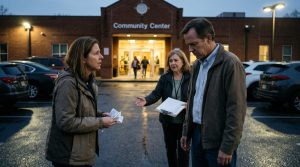
The Hope Street lot was dimly lit by flickering sodium-vapor streetlights, casting long, wet shadows on the cracked asphalt. Sarah parked in a dark corner, her engine idling, her eyes fixed on Mark’s truck. At 6:55 p.m., she watched him get out, lock the door, and walk toward the side entrance of the Hope Street Community Center.
She waited. For over an hour, her mind spiraled through every betrayal, every lie, every scenario that nine years of secrecy could conjure. Had he been living an entirely separate life? Another woman? A secret addiction? Her chest felt tight, her throat raw with a mix of fury and terrifying dread.
Just before 8:30 p.m., the side doors of the center opened.
Sarah’s breath hitched. A woman stepped out first—a tired-looking woman in a dark coat, clutching a bag. Mark followed closely behind her, accompanied by a small group of people. He was speaking quietly, his head bowed, in that gentle, deferential way he always did when he was deeply listening.
Sarah didn’t think. She opened her car door, her boots striking the wet asphalt with angry, echoing thuds. “Mark!” she called out, her voice cutting through the damp night air.
The group halted. Mark turned, his face instantly draining of color as he recognized her in the dim light. “Sarah?” he whispered, his voice catching in his throat. He took a step forward, then stopped, his eyes darting to the ground as if trying to locate a place to disappear.
“What is this, Mark?” Sarah demanded, her hands trembling as she pulled the crumpled bundle of receipts from her pocket and held them out like an accusation. “Every Wednesday for nine years. Three thousand eight hundred dollars. What are you doing here?”
Before Mark could find his voice, the woman who had stepped out first—the director of the center, a woman with kind, weary eyes named Eleanor—walked toward Sarah. She didn’t look angry; she looked infinitely sorrowful.
“Ma’am,” Eleanor said quietly, her voice carrying the gentle authority of someone who had seen every form of human heartbreak. “Your husband has been coming here since 2004. Every week. He was never alone in this.”
Eleanor held a clipboard in her hands, its pages worn and leafed through. She gently extended it toward Sarah.
Sarah’s eyes fell to the sign-in sheet. At the top of the page, in bold, utilitarian print, were the words: GRACE COMMUNITY CENTER — WEEKLY SUPPORT PROGRAMS.
Below it, under a column hand-labeled “Grief Support — Loss of a Child,” was Mark’s signature, dated for that evening, alongside dozens of others that stretched back through the years.
Sarah stared at the words. The ink seemed to blur and run on the page.
Loss of a child.
Their daughter, Lily, had died in the winter of 2004, just three days after she was born, due to a sudden and unpreventable cardiac defect. The grief had been an avalanche, burying them both. Sarah had spent years crying openly, attending therapy, and screaming at the unfairness of the universe, eventually finding a fragile, scarred version of normal. Mark, however, had always been “the rock.” He had handled the funeral, the bills, and the return to work without ever shed a visible tear in front of her. He had been her silent, unshakable shelter—or so she had thought.
Mark finally spoke, his voice barely more than a rough whisper. “After the baby… I watched you break,” he said, finally looking up, his eyes glassy and filled with an ancient, unspoken pain. “I saw how hard you were fighting just to get out of bed every day. I knew if I let myself fall apart, too, if I let you carry my grief alongside your own, we wouldn’t survive it. We would have lost each other.”
He took a slow, hesitant step toward her, his hands jammed deep into his pockets. “So I came here. I needed a place where I could say her name out loud without making you cry. I needed to learn how to carry it without dropping my end of the load.”
Sarah looked at her husband—this man who had ironed his shirt every Wednesday for nearly a decade, not to escape his life, but to find the strength to keep living it with her. She looked down at the crumpled parking receipts in her hand, no longer a ledger of betrayal, but a quiet, expensive monument to an enduring, protective love.
“Mark,” she breathed, the anger entirely gone, replaced by a deep, aching tenderness.
She walked the remaining distance between them, reaching out to take his hand. For the first time in nine years, under the flickering lights of the Hope Street lot, Mark Peterson let his shoulders drop, and the tears he had held back for a decade finally fell.