The Reserved Lane
The heavy scent of chlorine and old rubber mats always hit Carol first, a damp, indoor warmth that felt like an old coat. Every Tuesday for nine years, she walked through the locker room, her slide sandals slapping against the wet tiles, and made her way to the third lane of the YMCA pool in Shelbyville, Indiana.
Nine years. Since her husband, Arthur, had passed, the pool had been the one constant in a world that had shrunk around her. She was seventy-two now. In an aging, rusted corner of the American Midwest, where old storefronts crumbled and the winters were long, the Tuesday senior swim was more than just exercise; it was her anchor.
Every single Tuesday, Carol paid her $11 guest fee at the front desk, took her place in the third lane, and swam forty slow, deliberate laps. She wore the same dark swimsuit, the same worn swim jacket over her shoulders when she got out, her wet silver hair clinging to her neck. She paid in cash, counted out to the penny, exactly $11, week after week. It was a routine she performed like a prayer.
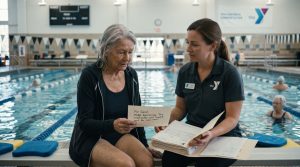
But on this particular Tuesday, as Carol sat on the aluminum bench at the pool’s edge, still breathing heavily from her laps, the YMCA’s director, Marissa, walked over. She was a woman in her early forties with a kind, busy demeanor, wearing a navy YMCA staff polo.
In her hands, she held a thick, worn manila folder.
“Carol,” Marissa said, her voice dropping into a gentle, confidential register as she sat down on the bench beside her. “Do you have a few minutes?”
Carol’s hand went instinctively to the collar of her swim jacket. “Is everything alright, Marissa? Did the guest fee go up?”
“No, Carol. Nothing like that,” Marissa said, opening the folder on her lap. She let Carol see the stack of bank-stamped papers and ledger sheets inside. “I was going through our long-term community accounts this morning, updating our system, and I found something. These statements show that an account was set up in early 2016. It was prepaid through December of 2025.”
Carol stared at the paper, her brow furrowing in confusion. “Prepaid? By whom?”
“By Arthur,” Marissa said softly, her eyes searching Carol’s face. “He came in here, just a few days before his last doctor’s appointment back in 2016. He didn’t tell you, did he?”
 The indoor pool area seemed to fade, the sounds of splashing water and distant laughter from the children’s swim class down the way suddenly muffled, as if Carol had gone underwater. Her ears were ringing.
Marissa gently pulled a small, aged piece of paper from the top of the file and handed it to Carol.
It was a piece of scrap paper, yellowed at the edges. But the handwriting was unmistakable—the slightly shaky, forward-slanting cursive of her husband, Arthur.
“For Carol. Keep swimming. The instructor will watch out for you now.”
Carol’s breath caught, her fingers trembling as she took the paper. She stared at the words, her eyes blurring with sudden, hot tears.
“Nine years,” she whispered, her thumb brushing the faded ink of his name. “He paid for all of this?”
“He did,” Marissa said, her hand reaching over to gently cover Carol’s. “Every single Tuesday. He knew how much the water helped your back, Carol. He knew how much you loved the pool. When he got his diagnosis, he knew you would be on your own, and he knew how easy it is to just… stop. Stop going out. Stop living. So he came in here and paid for ten years in advance. He made us promise to let you pay your guest fee every week if you wanted to, just so you’d keep your routine and feel like you were still part of the world.”
The realization hit Carol like a wave, a visceral, overwhelming rush of love and grief. Arthur had been gone nearly a decade, yet his care, his protective presence, was still here, shielding her every single week. He had spent his final, precious days—when his own body was failing him—making sure she would have a lane, a warm room, and a community of people looking out for her when he couldn’t.
In the United States, where aging can often feel like being quietly discarded, where the costs of simply existing are relentless, Arthur’s prepaid folder was a monument of unconditional love, a quiet guarantee of her dignity and place in the world.
Marissa set the folder down, her voice a gentle murmur as Carol let the tears finally fall. “Carol, he asked me to tell you he kept every receipt. He knew you’d be worried about the money, but he said this was the best investment he ever made. Every single lap you swam, he was there with you.”
Carol sat on the bench, clutching the small scrap of paper to her chest, her face wet as she looked out over the sparkling water of Lane Three. The pool was still there. The people were still there.
Arthur’s lane would always be reserved. And she would keep swimming.
The visual journey capturing Carol’s emotional discovery of her husband’s secret legacy at the indoor YMCA pool highlights this poignant, authentic slice of life. Please find the image below capturing this exact moment, from the damp towels to the weathered handwritten note. Let me know if you would like me to adjust any of these scenes or add to the story!