The Ledger of Grace
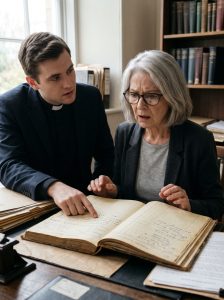 The smell of old paper and dust is always stronger in the basement of Grace Community Church. For fourteen years, that smell had been my comfort. As the church treasurer, I had loved the predictability of it—the neat columns, the bank statements, the quiet click of my calculator as I accounted for every bake sale dollar and every crumpled ten-by-twenty-dollar bill dropped into the offering plate on Sunday mornings. It was a humble, honest task. I was Naomi, the trusted one, the steady hand.
But last Tuesday, the air in the small office felt heavy enough to suffocate me.
Pastor Ethan, our newly appointed minister—scarcely thirty, eager, and painfully earnest—had asked me to come in to examine some boxes he’d pulled from the deep storage closet behind the sanctuary. He had been trying to piece together a history of the building’s deferred maintenance, specifically why the long-promised structural repairs on our historic roof and foundation had simply stopped in 2011.
“I found this old ledger, Naomi,” he’d said, gently placing a worn, frayed canvas-bound book on the desk between us. “It was buried at the back of a filing cabinet. Your name is on the early audits, but some of the transactions toward the back seem… incomplete.”
He opened it, and as my eyes fell on the handwritten pages, my throat closed.
There, in the fading ink of 2011, were the numbers. My brother, Marcus, had been the church deacon back then, a charismatic, beloved figure in the parish. But I knew the truth that no one else did. In late spring of that year, Marcus had come to me, sweating, his hands shaking as he confessed to a “temporary cash flow issue” with a local business venture. He’d begged for a short-term, unrecorded loan from the building fund to cover a gap. Just $9,200. He was my brother, the man who had helped raise me after our parents passed. I had looked at the bank statement, seen the missing money, and said nothing. I had initialed the audit. A loan, he’d promised. Just three weeks.
But a three-week loan became nine months of agonizing phone calls, hushed arguments in the church parking lot, and increasingly desperate lies. Over nine months, the transfers had reached a staggering $47,000. And the building repairs? They never happened. I had covered for him, year after year, hiding the missing funds in complicated depreciation schedules and forgotten “project reserves” until Marcus resigned and moved out of state, leaving behind a crumbling building and a sister carrying a terrible, secret shame.
“Naomi?” Pastor Ethan’s voice brought me back. He was pointing to the bottom of a page from October 2011 (image_5.png). His finger hovered near a tiny, scrawled note in Marcus’s handwriting that I had never seen before.
My eyes strained through my glasses. “Covered by my sister so the church won’t ask questions.” My initials, “N.S.,” were right next to it, confirming the audit.
“My mouth went dry,” I whispered, the words barely audible.
“It looks like there was a transfer of $47,000 that never went to the contractor,” Pastor Ethan said, his voice gentle but probing. “The deacon board meets tomorrow night to discuss the new capital campaign, and they want to do a full review of historical funds. They still think you’re the honest one who can help us make sense of this.”
I sat in that chair for what felt like an eternity, the old paper rough under my fingertips. The truth was there, in black and ink. I wasn’t just a protective sister anymore; on paper, I was an accomplice to fraud. Marcus had used every cent of that money to feed a gambling addiction that eventually destroyed his marriage and his life, though the community only ever knew him as a “troubled, retired deacon.” And now, the board was going to look to me—the “honest” treasurer—to explain where the foundation money went.
That night, sleep was an impossibility. I walked the creaking floorboards of my small house, my mind racing. I could lie. I could blame a bank error, or suggest the records from that era were lost, or that Marcus had somehow falsified my initials. The board trusted me completely; they always had. But the thought of carrying that lie into my twilight years, under the roof of the church I had loved my entire life, felt like a slow, crushing death.
The next evening, the deacon board convened in the church parlor. The room was warm, filled with the familiar faces of people I had known for decades—Bob, who owned the hardware store; Martha, who ran the food pantry; and Sarah, whose father had helped build the very pews we sat on. They were drinking coffee, joking about the drafty windows, and waiting for my financial update.
Pastor Ethan sat at the head of the table, the ledger resting before him like an unexploded bomb.
“Naomi,” Bob said, leaning forward. “We’re glad you’re here. We want to make sure we have our history straight before we ask the congregation for another hundred thousand for the roof. Can you walk us through what happened to the 2011 building fund? We always thought the contractor had just overcharged us.”
The room went quiet. All eyes turned to me.
I looked at the worn faces of my neighbors, people who had supported me when my husband passed, who had trusted me with their tithing, their confidences, and their community’s future.
“I can’t tell you the contractor overcharged us,” I said, my voice trembling, but gaining strength with every word. I took a deep breath, reached into my purse, and pulled out my own set of notes. “Because the money never went to a contractor.”
The parlor was utterly silent as I began to speak. For thirty minutes, I laid bare the truth I had carried for over a decade. I told them about Marcus’s desperation, his addiction, and my own catastrophic failure of courage. I didn’t hold back. I explained how I had seen the first $9,200 and chosen family over faith, and how that choice had snowballed into $47,000 of stolen, unrecoverable community trust.
“I wanted to protect my brother,” I said, tears finally spilling over my lashes. “But in doing so, I betrayed this church, and I betrayed all of you. My initials are on those ledger pages because I signed off on the lies. I am so deeply, deeply sorry.”
When I finished, I sat back, bracing myself for the anger, the hushed whispers, the inevitable demand for my resignation. I looked down at my hands, unable to meet their eyes.
For a long moment, no one spoke. The only sound was the ticking of the old clock on the mantelpiece.
Then, Sarah, who sat across from me, reached across the table and placed her hand over mine.
“Naomi,” she said, her voice thick with emotion. “We are heartbroken about Marcus. But we’ve known you for forty years. We know the burden you’ve been carrying. It took courage to say this.”
“It doesn’t change the fact that the money is gone,” I whispered, my heart aching. “And I cannot pay it back.”
Pastor Ethan spoke up then, his voice calm and reassuring. “We cannot undo the past, Naomi. But grace isn’t about ignoring the debt; it’s about facing the truth together. You’ve given us the truth. Now, we can figure out how to heal.”
In the hours that followed, the board didn’t banish me. Instead, we sat together, not as judge and jury, but as a community. We talked about how to address the historical gap in the church’s records, and how to move forward with the capital campaign with complete, transparent honesty.
When I finally walked out of the church basement that night, the chilly autumn air felt different. The smell of the old office was still there, but the crushing weight on my chest was gone. For fourteen years, I had been the keeper of a dark, silent secret, but in the light of truth and grace, the ledger was finally clear. I had lost my “perfect” reputation, but I had found my home again.