The Price of Peace
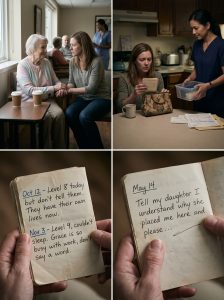 The fluorescent lighting in the foyer of Autumn Grace Assisted Living always smelled faintly of lemon wax and industrial laundry detergent, a scent that had become the backdrop of my life for twenty-six months. Every second and fourth Sunday, I would make the drive out to the facility in suburbs of Cleveland, rushing from my job as a mid-level manager at a logistics firm, my mind cluttered with spreadsheets, mortgage payments, and my teenager’s school schedule.
My visits to the facility were always short, cramped between the demands of a life that never seemed to have enough hours. But my mother, Clara, never complained. When I would walk into her small, shared room, her face would instantly light up. She would be sitting in her armchair by the window, wearing a pastel cardigan, and her first words were always a soft, reassuring, “Oh, Grace, you look busy. How is everything?”
I’d sit on the edge of her bed, holding her hand, and ask how she was doing. “Everything is fine, honey,” she’d say, her smile gentle and unwavering. “The staff is so nice, and the food is good. Don’t you worry about me. Go on back to your family.”
I wanted to believe her. I needed to. The bills for Autumn Grace were $8,400 a month, a staggering sum that had drained my mother’s modest savings, swallowed my father’s small life insurance policy, and was now actively eating into my own family’s monthly budget. Twenty-six months straight. It was a crushing, invisible weight that Arthur, my husband, and I talked about in hushed, anxious whispers at night while our children slept. Every time I looked at those invoices, a cold, suffocating guilt would rise in my throat. I had placed her there because she had started falling, because we couldn’t keep her safe at home while Arthur and I both worked fifty-hour weeks to stay afloat. It felt like a failure, a transaction that traded my mother’s independence for our survival.
But Mom always smiled. “Everything is fine,” she’d say, and I let myself take the comfort she offered, using it as a shield against the crushing reality of what we were paying to keep her there.
Then, last week, her heart finally gave out. She passed away quietly in her sleep on a rainy Thursday morning.
The room was silent when I went to collect her few belongings. As I packed her cardigans and framed photos into cardboard boxes, Elena, a longtime night nurse who had been close to my mother, stepped into the room. She held a worn, floral-patterned purse that had belonged to my mother for decades.
“I thought you should have this, Grace,” Elena said, her voice quiet and thick with emotion. “She kept it close to her, right in the drawer by her bed.”
I took the purse, the aged fabric cool and heavy in my hands. Back home, after the funeral, I sat at my kitchen table, a cold cup of coffee in my hand, and finally opened it. Inside were her old keys, a few faded receipts, and a small, spiral-bound paper notebook.
I opened it, expecting to find grocery lists or phone numbers of old friends. Instead, I found a meticulous, heartbreaking record.
Page after page, listed in my mother’s shaky handwriting, were dates and pain levels.
“Oct 12 – Level 8 today but don’t tell them. They have their own lives now.”“Nov 3 – Level 9, couldn’t sleep. Grace is so busy with work, don’t say a word.”“Jan 18 – Terrible pain in my back. When Grace came, I made sure to sit up straight. I don’t want her to worry. She has enough on her plate with those bills.”
My coffee went entirely cold in my hand as the realization crashed over me. She had been hiding everything.
For twenty-six months, while we were struggling to pay the $8,400 a month that we thought was buying her a safe, comfortable end of life, my mother had been enduring severe, constant pain, entirely in secret. She had actively hidden her decline, downplaying her symptoms and refusing to tell the staff or me because she knew how hard we were working to keep her there. She knew what the bills were doing to us, and in her quiet, fiercely protective way, she had decided that her pain was a small price to pay to keep us from breaking under the weight of her care.
She hadn’t been “fine.” She had been a soldier, fighting a silent, agonized battle so that her daughter and grandchildren wouldn’t have to carry the burden of her suffering. “They have their own lives now,” she had written, a phrase that felt like a knife in my heart. She had seen our struggle, our hurried visits, and the tension we couldn’t entirely hide, and she had chosen to protect us by keeping her pain behind a gentle, reassuring smile.
I sat on the kitchen floor, the tiny notebook clutched to my chest, as the guilt I had carried for years transformed into an overwhelming, devastating wave of love and grief. We had been paying a fortune to keep her “safe,” but the real price—the emotional cost of her silent sacrifice—was something no invoice could ever capture.
I turned to the final page. It was dated May 14, just three days before she died. The handwriting was incredibly faint, the pencil pressing lightly into the worn paper, the words barely visible:
“Tell my daughter I understand why she placed me here and please… tell her to let herself be happy. It was all worth it.”
The sentence trailed off, a final, incomplete thought from a mother who, even in her last days, was still trying to shield her child from the shadow of regret.
She had understood. She hadn’t felt abandoned; she had seen the choice we were forced to make in a world where care is a luxury and time is a commodity we can’t afford, and she had met that choice with the only thing she had left to give: her silence.
I closed the notebook, the tears finally breaking through the numbness. She had forgiven me for the choice I had hated myself for making.
On Saturday, Arthur and I took our kids to the park on North Broadway. The air was crisp, and the kids were running through the grass, their laughter a sharp, vibrant contrast to the quiet of the last few weeks. Arthur sat beside me on the bench, his hand resting over mine, knowing the heavy weight I was still carrying.
I looked at my family, then down at the small notebook in my bag. I had a lot of years to make up for, and a lot of grief to process, but as I watched my children play, I knew my mother’s unfinished sentence had finally found its ending. She had paid for her peace, and now, it was time for me to finally let myself find mine. Below are the images from our journey.