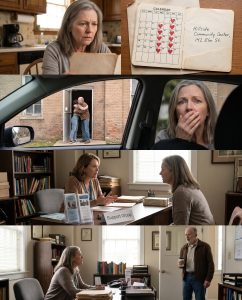
 The Ohio winter had a way of flattening everything, turning the sky the color of wet concrete and keeping us indoors, where the silence had plenty of room to stretch. Our house in Youngstown had always been quiet, but for the last few years, since our daughter Chloe had left under a storm of anger, regret, and broken promises, that silence had become heavy. I had made my peace with the fracture. “She is dead to us,” I had told my husband, Arthur, on the night she stole her grandmother’s silver to buy what she couldn’t live without. I meant it. I had to, just to keep from breaking completely.
But Arthur hadn’t been himself for over a year. He was more distant, his eyes always wandering to some point over my shoulder. And then there were the Fridays.
Every Friday, right around four in the afternoon, Arthur would put on his coat, pat his pocket, and head out. “Men’s prayer group at the church, Eleanor,” he’d say, not quite looking at me. “We’re studying the old texts.”
He’d return hours later, cold but quiet, smelling of cheap coffee and old books. I never questioned it. Faith is a lonely business, and we both needed whatever comfort we could find.
But then I found the calendar.
It was tucked behind the manuals in the desk drawer—a small, worn paper pocket calendar Arthur must have gotten from the hardware store. It shouldn’t have caught my eye, but a scrap of paper was sticking out. When I opened it, my breath caught.
A hand-drawn red heart, small and careful, marked every single Friday for the last fourteen months. Next to the final heart, someone had scribbled an address: Hillside Community Center, 142 Elm St.
A cold, sharp panic flared in my chest. A heart? Every Friday? A prayer group didn’t need hearts, and it certainly didn’t meet at the dilapidated community center on Elm Street, a part of town we had no business visiting. My mind, trained by years of worry, immediately went to the worst: another woman, a secret life, a betrayal I didn’t think we could survive.
The next Friday, my hands were shaking as I key-started our old Subaru. I didn’t say anything to Arthur when he left at 3:45 PM. I just waited five minutes, then followed the route I knew by heart.
The Hillside Community Center was a weathered brick building, the kind with chain-link fences and peeling paint. I parked across the street, the engine idling, my eyes fixed on the entrance. My mouth went entirely dry when I saw him.
He was walking up the concrete steps, his shoulders hunched against the wind. And there, waiting at the door, was a young woman. She was about twenty-five, wearing an oversized thrift-store jacket, her dark hair pulled back in a messy bun.
She took one look at him and threw her arms around his neck. Arthur didn’t hesitate; he held her tight, his hand resting on the back of her head with a familiarity that made my heart stop.
My grip on the steering wheel tightened until my knuckles were white. The betrayal was a physical blow, but as I stared through the glass, something else hit me—something in the way she moved, the slight, nervous tilt of her head.
It wasn’t another woman.
It was Chloe.
I sat there, the car heater humming, as the world seemed to tilt. Chloe. She was alive. She was here, in Youngstown, and my husband had been seeing her every single Friday while I sat at home, believing she was gone forever.
I couldn’t stay in the car. The anger, the confusion, and a desperate, clawing need to understand pushed me out into the cold. I crossed the street, my boots crunching on the frozen gravel, and walked through the heavy double doors.
The foyer was noisy, filled with the hum of voices and the smell of stale coffee. I found my way to the administrative wing, my heart hammering against my ribs. I must have looked lost, because a woman with kind, tired eyes and a clipboard stopped in the hallway.
“Can I help you?” she asked.
“I… I’m looking for Arthur,” I managed to say. “Arthur B.”
The woman’s expression softened instantly. “Oh, Artie. He’s in the family room. I’m Sarah, the director here.” She looked at me, her gaze lingering on my face. “Are you Eleanor?”
I nodded, unable to speak.
“Come with me,” she said, leading me into a small, carpeted office. “He’s just finishing up, but I think you should know what he’s been doing.”
She shut the door, offering me a chair, but I couldn’t sit. “He told me he was at a prayer group,” I said, my voice cracking. “Every Friday.”
“In a way, he was,” Sarah said gently. “Your husband has been attending our family support meetings for over a year. He’s here every week, Eleanor. When Chloe came to us, she was at her absolute lowest. She didn’t want you to know—she was too ashamed, too terrified of what she’d done to this family. But Arthur… he couldn’t let her go. He came here to learn how to support her without enabling her. He sat in these rooms, took the hard knocks, and did the work.”
She smiled, a small, hopeful thing. “Your daughter is doing really well now, Eleanor. She’s eleven months sober. She’s working in our kitchen, and she’s trying to put her life back together. Arthur has been the only bridge she had left.”
At that moment, the door clicked open. Arthur walked in, holding a paper coffee cup, his eyes downcast as he murmured an apology for the interruption.
Then, he saw me.
His face went entirely white, the paper cup trembling in his hand. He looked from me to Sarah, and then back again, the years of secrecy and the heavy, exhausting burden of his double life visible in the slump of his shoulders.
“Eleanor,” he whispered, his voice barely audible. “What… what are you doing here?”
“Eleven months, Arthur?” I asked, the tears finally breaking through. “You’ve been here every Friday?”
He swallowed hard, stepping fully into the room and closing the door behind him. He didn’t look angry; he just looked incredibly, profoundly tired.
“You told me she was dead to you after what she did,” he said, his voice thick with a quiet, desperate emotion. “You were so broken, Eleanor. I saw what the stress was doing to you, and I knew you couldn’t take another relapse, another disappointment. I promised her I wouldn’t tell you until she was ready, until she was safe. I couldn’t tell you I was still… I was still her father.”
The silence in the room was heavy, filled with the ghost of the girl we had lost and the man who had refuse to let her go. He had kept the secret to protect me, yes, but more than that, he had kept it to protect the only tiny, fragile hope we had left.
“Is she… is she really okay?” I asked, the anger entirely gone, replaced by a vast, aching need to believe.
Arthur looked at me, the guard finally dropping from his eyes. “She’s trying, El. She misses you. She’s wanted to come home every single day, but she didn’t think you’d ever want to see her.”
I looked at my husband—the man who had carried this heavy, hidden grace for fourteen months, smelling of the coffee and old books of a community center basement, all to keep our family’s spark from going out.
“I want to see her, Arthur,” I said, my voice barely a whisper. “Please.”
He didn’t say a word. He just reached out, took my hand—cold but steady—and led me out of the office, down the hall toward the kitchen. The burden of our years didn’t vanish, but for the first time, we weren’t carrying it in the dark.
Saturday was just another cold Ohio day, but for us, it was the start of something new. Below are the images from our journey.