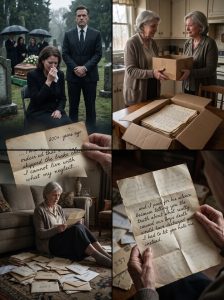
 The funeral was on a rainy Tuesday in the fall of 2007. I remember the exact smell of the wet wool on the dark coats, the heavy, muddy Ohio soil, and the absolute, shattering weight of a tiny, flower-covered casket that held our nineteen-year-old son, Michael.
My husband, Thomas, stood beside me like a sentinel. While I wept until my eyes were swollen shut, grasping at the hands of neighbors and churchgoers, Thomas did not shed a single tear. His jaw was clenched, his hands clasped tightly in front of him, and his eyes stayed fixed on a distant, invisible point above the grave. He looked like a man watching a stranger’s tragedy.
“How can you be so cold?” I asked him, our first night back in our quiet house. He had been staring at a blank wall, unresponsive to my grief, the silence between us as heavy as a tomb. “Our boy is gone, Thomas. He is gone.”
He had looked at me with an unreadable, flat expression and said, “He’s gone, Margaret. There’s nothing to be done.”
His silence wasn’t just distant; it felt like an accusation. Within eight months, the emptiness of Michael’s room, combined with Thomas’s refusal to mourn or share my pain, became too much. We divorced quietly, the paperwork a formality for a marriage that had already died on the highway. I stayed in the house, eventually growing older, while Thomas moved into a small apartment on the edge of town, disappearing from my life. He never remaried, and our sporadic, strained interactions at family functions or church became less and less frequent until they stopped altogether.
When he passed away last winter, nineteen years after the crash, I felt a familiar, dull ache. A neighbor from his apartment complex called to let me know, but I didn’t go to the service. There was no closure to be found in the memory of a man who had seemed so entirely unbothered by the loss of our only child.
Two days later, my phone rang. It was Brenda, a longtime friend from church who had been helping Thomas’s sister sort through his few belongings.
“Margaret,” she said, her voice shaking slightly. “There’s a box. Thomas’s sister has been keeping it, and she came to me. She said Thomas made her swear to wait until after he passed to give it to you. I’m bringing it over.”
When Brenda arrived, she didn’t stay long. She handed me a worn, cardboard box—its corners taped and frayed—and gave me a gentle, emotional look. “He lived a very quiet life, Margaret. But he never forgot.”
I placed the box on the kitchen table, the paper cool and heavy. Opening the lid, I expected to find old tax documents or perhaps a few of Michael’s childhood items we hadn’t split. Instead, I found a stack of hand-written letters.
They were organized in precise, chronological order, held together by faded rubber bands. At the top was a date: October 2007.
I pulled the first stack out, my hands trembling as I opened an envelope. Written on inexpensive notebook paper in Thomas’s shaky, uneven script, it read:
October 28, 2007To Margaret,It’s Sunday night. You’re asleep upstairs, and I’m in the kitchen, listening to the rain. I can hear you crying through the ceiling sometimes, even when you think I can’t. I want to come to you. I want to hold you and tell you I’m sorry. But I cannot. I cannot look you in the eyes and tell you that Michael is gone because I didn’t take his car for the brake check. He had asked me to look at the front pads, and I told him it could wait until the weekend. If I had just taken it, if I had just checked them myself, the truck would have stopped. I killed our boy, Margaret. I didn’t check the brakes. My neglect is what cost us our son. Every time you look at me, I see you looking at a murderer. I can’t let you see how broken I am, because you will look at me and know I failed you both. I’m so sorry. I am so sorry.
I gasped, the paper slipping from my fingers. I sat on the living room floor, my back against the sofa, as my mind reeled.
“I skipped the brake check,” he had written.
I began to open another, then another. They were dated week by week, every Sunday night for years. One for every single week since the crash.
August 14, 2009 – Another week, Margaret. I saw you at the store yesterday. You looked so tired, and you didn’t look back. It’s what I deserve. I can’t live with what my neglect did. If only I had taken that five minutes. If only I hadn’t been so lazy. I sit in this apartment, and I can still hear the sound of the metal. I am so sorry.
Each of the 237 letters was a confession, a painstaking record of a father who had been crushed by the weight of a silent, agonizing guilt. He had blamed himself for the accident, believing that his failure to inspect the vehicle had caused the brakes to fail, leading to the collision on the icy highway.
My back ached as I sat there, the envelopes scattered on the rug around me, the ghosts of our past finally speaking after nineteen years of silence. He hadn’t been cold. He had been utterly, profoundly broken, so consumed by self-loathing that he had chosen to let me hate him rather than force me to bear the truth of what he believed was his own failure.
Finally, I reached the bottom of the box. The final letter was in a separate, sealed envelope, dated only a few weeks before his death.
February 12, 2026Margaret,If you are reading this, I am finally at peace. Or at least, I hope so.I need to tell you the final truth, the part I couldn’t write in the other letters. The other driver’s name was Michael’s friend, Justin. He was the one who survived that night, the one who walked away.I paid for his silence because telling you the truth about what really caused our boy’s death would have destroyed you. You loved Michael so much, you saw him as your perfect, sweet boy. But Justin showed me the text messages. Michael was on his phone. He was texting Justin, racing to see him, completely distracted, when he ran that stop sign. It wasn’t the brakes, Margaret. The police report would have shown it, but I begged them, and I paid Justin’s family to keep the lawsuit quiet, to keep the investigation from the papers, to protect Michael’s memory for you. I wanted you to think it was just a tragic, unpredictable failure of the machine, or even my fault—anything but the truth. Because if you knew Michael’s own hand, his own youthful mistake, had taken him from you, I knew you would never find a way to survive the grief.I had to let you hate me instead of our boy. I let you think I was the careless one, the neglectful one. I took the blame so Michael could remain your angel.I have loved you, Margaret, and I have loved our boy every day. I hope you can find a way to forgive me for the silence.Thomas.
The paper was damp with my tears. The truth—the terrible, beautiful, sacrificial truth—sat heavily on the living room floor.
He hadn’t been cold. He had been a protector, carrying the dark, agonizing truth of Michael’s death alone in the quiet of his own heart, sacrificing his own marriage, his own peace, and his own reputation to shield the mother of his child from a grief he believed would have killed her. He had chose to be the villain so our son could remain the hero.
I looked at the scattered letters, tracing the faded ink of his pen. For nineteen years, Thomas had lived in a prison of his own making, a keeper of the bridge that he had built to keep me safe.
I sat on the floor, the faded blue ink blurring as I clutched the final letter to my chest. He had paid for his silence, but now, the truth was finally free, and for the first time, I felt the heavy, quiet peace of a husband who had loved me from the dark.
I went to the cemetery the next morning. There were no umbrellas this time, just the crisp autumn air and the quiet, dry leaves rustling underfoot. I walked to the grave where they had recently buried Thomas, right beside our Michael.
I knelt down on the damp grass, placing the worn final letter on the earth.
“I know, Thomas,” I whispered, the weight of the years finally lifting. “I know. And I forgive you.“